Showing posts with label movies. Show all posts

Wednesday, August 31, 2016

Florence Foster Jenkins

Music students who are fans of opera - or who, like me, were friends of fans of opera - inevitably get exposed to the singing of Florence Foster Jenkins.  Imagine a late night, a group gathered in someone's dorm room, everyone's well stoned listening to all kinds of music.  Eventually, without explaining, someone plays Florence's album.  Hilarity ensues.  It's better when you don't know what to expect.

If you aren't familiar with Florence's work, here's a recording.  Enjoy:


It's natural to wonder whether Florence Foster Jenkins was having a little joke on her audiences.  No, apparently not.  All evidence suggests that Florence was completely serious.  I mean, she was no Darlene Edwards.  Florence was, at least in her own mind, a serious artist.

And that's just the beginning of her tale.  The whole story would make a good movie.

Oh right.  That movie is out now.  It's entitled Florence Foster Jenkins and stars Meryl Streep as the eponymous prima donna.  Since Florence seems like a perfect patron saint of Illusory Superiority (which is the pop psychology trope I have recently adopted as a feeble excuse for not fulfilling my own lofty career expectations), I was tremendously anxious to see it.  I dragged Leslie off to a local theater last week.   Here's the trailer.


I think the essential point is that Florence Foster Jenkins is a love story.  Bad singing is just the hook.  Florence and her husband, St. Clair Bayfield (played by Hugh Grant) had a non-traditional marriage.  Theirs was clearly a loving supportive relationship.  Co-dependent even.  I ended up rooting for Bayfield to help Florence succeed.

It's a good movie because of the acting.  Streep makes you feel that this might have been what the real Florence was like.  And she mimics Florence's singing exceptionally well.   Grant is perfectly cast.  Simon Helberg, who plays the accompanist Cosme McMoon, escapes his Big Bang Theory persona and holds his own against these two formidable talents, although I found his high voice annoying.  On the other hand it was a pleasure to watch an actor actually playing a piano instead of faking.

I even liked the sound track by Alexandre Desplat - especially the Rota/Fellini-esque cue as the crowd streamed into Carnegie Hall.   The best musical moment, in my opinion, happened just after the scene where Florence and Cosme play a Chopin prelude together.  The scene cuts outside while the music transforms perfectly into the John Kirby arrangement of that same music; sad, mournful and very 40's. 

Another oft-mentioned moment shows Florence singing while we hear her presumably as she heard herself.  It's excellent singing, also sung by Meryl Streep.  Here's where I suspect the common perception of Florence Foster Jenkins goes slightly awry. 

It's been suggested that Florence's hearing was affected by the mercury treatments given for her syphilis.  The movie shows her enjoying Lily Pons' excellent singing.  It's possible that what Florence actually heard when she herself was singing was the same thing she heard when she listened to Lily, both performances would have been scrambled by a maladjusted auditory system.


In my twisted version, we would have heard Lily Pons in concert through Florence's ears rather than hearing Florence through Florence's ears.  And in Florence's ears, Lily Pons would have seemed (to us) just as distorted and out of whack as Florence actually sounds.  Maybe everything sounded different to Florence - her own audio universe.  Florence set her own standard for excellence.  Music sounded like that to her and she loved it.

It would be fascinating to learn the results of whatever audiometric tests Florence might have taken.  (I've not heard of any.)  You can anonymously test your own hearing right online - pitch acuity or tone deafness.  Give it a whirl.

Like most movies Florence Foster Jenkins has a villain - a critic from the New York Post named Earl Wilson, portrayed by actor Christian McKay.  His big line is "Music will not be mocked."  On the other hand, maybe the real villain is any classical music fan, professional critic or not, who is just too serious about this stuff.  (And, I've never understood how newspapers in the 1940's could run reviews of concerts the next morning - while newspapers of today can't.)

If you're interested in the real story behind the movie, here are two good sources I've found.  The first is at a site called History Versus Hollywood.  Also watch this documentary "Florence Foster Jenkins: A World Of Her Own" by Donald Collup.  It's excellent.  I enjoyed all the first person reminiscences about Florence and the real life confirmations of some of the stranger scenes in the movie.

Also don't miss the picture of Cosme McMoon with Arnold Schwarzenegger.


In this documentary, starting at about 1'14", several actual reviews of Florence's Carnegie Hall recital are read.  I've transcribed them here:
NEW YORK POST by Earl Wilson  Hey you music lovers, I heard Madame Jenkins.  Mrs. Florence Foster Jenkins, 76, a widow lady of our town, has a great voice.  In fact she can sing anything but notes.  Lady Florence, or Madame Jenkins, as she likes to be called, if you are thinking of her as an artiste, indulged last night in one of the weirdest mass jokes New York has ever seen.  I witnessed it.  She gave a quavering recital at Carnegie Hall on a stage filled with flowers to resemble an expensive mortuary.  She hired the hall.  She filled it with three thousand people with an acute sense of humor who paid about $6000 for the privilege of snickering squealing and guffawing at her singing, which she took very seriously.  
I sat in row T and around me I heard people saying "Shh.  Don't laugh so loud." "Stick something in your mouth."  "We were jackasses for coming."  "She didn't hit three notes in that one."  "Now that one wasn't bad at all."  But Mrs. Jenkins today can brag that she probably packed in more than Lily Pons could.   "Bravo!" roared the playful listeners.  She heard some of them laughing.  It came, she said, from those hoodlums.  Which hoodlums?  The hoodlums planted in the audience by her enemies of course.  When she walked onto the stage in white and with a large white ostrich fan, she looked like a plump apparition.  The mirth exploded when she took her place beside some flowers as big as a small tree.  From all over the house came the laughs - at the wrong time.  "I'm no music expert," Irving Hoffman (who isn't, either) remarked, "She hit only a few notes."  The rest were promissory. 
It was a great show she gave.  Her accompanist, Cosme McMoon, leaped up and kissed her hand in courtly fashion after several numbers. She got herself mixed up flinging some rose petals and singing Clavelitos.  The first one she undertook to throw stuck to the end of her finger.  She kept trying to pitch it off and it was like some one frantically trying to divest oneself of some flypaper.  Even the rose petals were playing.  And, incidentally, she walked away with about four G's last night.  Maybe the joke's on us.  None of us walked away with anything except dizziness, a headache and a ringing in the ears.  
          =-=-=-=
NEW YORK SUN by Chester Thompson -  It was largely a recital without voice.  For the tones Madame Jenkins produced were tiny to the point of disappearing.  Most of her singing was hopelessly lacking in a semblance of pitch.  But the further a note was from its proper elevation, the more the audience laughed and applauded.  And the upper notes, when they could be heard, had an infantile quality.   But the audience always backed up its laughter with thunderous applause and everybody had a pleasant evening.  
          =-=-=-=
WORLD TELEGRAM by Robert Bagar  The quarter tone touch.  Of all the singers appearing before the public today, only Madame Jenkins has perfected the art of giving added zest to a written phrase by improvising it in quarter tones, either above or below the original notes.  Think of the difficulties involved in making this possible.  She was exceedingly happy in her work.   It is a pity that so few artists are, and the happiness was communicated, as if by magic, to her hearers, who were stimulated to the point of audible cheeriness, even joyous laughter and ecstasy by the inimitable singing.  A night of nights in the musical annals of this fair city.    

So, what's the moral of the story?

It would appear that Florence Foster Jenkins was, as so many of us are, a devotee of the magical power of music - there's a strong positive psychic payback for listening, creating or performing music.  She had ample determination and resources to overcome any obstacles to participating in music making.  It was her right to pursue something that made her feel good.

As long as she followed her bliss in private, for her friends, things were okay.   Florence's problems really began when she opened herself to public criticism.  It can be difficult to accept the negative judgements of others.  The public simply does not hear things the same way you do.  Discovering this could kill you.

And yet, decades later, Florence is still fondly remembered.  Her recordings still give us pleasure - much in the same way the audience got pleasure, as reported by these music critics, at Carnegie Hall.  Besides this movie there are books and plays about her.   Despite her naive cluelessness, her alternative musical interpretative style represents a very real, very unique talent.  And that talent has been clearly validated by her audience over the years.  Hers was the power to transmit happiness.  The danger, either for music critic or coloratura soprano, comes when you take yourself just too seriously.

It's not impossible that Florence's fame will continue to grow.  That has happened to other great musicians.  J.S. Bach comes to mind.  The question is not so much what they accomplished during their lifetime but how we, the listeners, regard those accomplishments right now.
the happiness was communicated, as if by magic, to her hearers, who were stimulated to the point of audible cheeriness, even joyous laughter and ecstasy by the inimitable singing.


Here's a photo of the crowd at Florence's Carnegie Hall recital:


As far as I can tell, this movie actually looks like the 1940s in New York City - in full color yet. Yeah, a few bloopers are listed on IMDB, the biggest being (I think) that parts of the story were compressed into a much shorter time span.  The bustling New York street outside Florence's hotel is actually in Liverpool and who knows how much digital cleanup was required to send the exterior of Carnegie Hall back in time.   Period costumes and technology and set design - all good.   I laughed at Florence's battle with a roll of old-fashioned cello-tape.

In this video Meryl Streep mentions that the she recreated Florence's entire Carnegie Hall recital for a live audience and that it can be found in the extras section of the DVD.  I'm looking forward to that. Also, in the same video Donald Collup talks about Florence's hearing problems, including tinnitus (a ringing in the ears.).


The actors Nina Arianda and Stanley Townsend who played the comic characters Agnes and Phineas Stark, real "New Yawkers", deserve a mention.  The least musically "authentic" scene in the movie - in my opinion - was Florence's singing lesson with vocal coach Carlo Edwards played only for laughs (by actor David Haig).  One wonders if, in real life, anyone ever suggested to Florence that she might want to practice matching pitches.


In this program of Florence's recital, note the name Pascarella Chamber Music Society.  When I was studying at CalArts (in the 70s) there was a gentleman on the faculty named Cesare Pascarella.  He and his brothers apparently performed quartets while Florence changed costumes.  I guess those of us who knew Cesare were only one handshake away from Florence herself.

You can see other pictures of Florence here


Saturday, November 28, 2015

The Meaning of a Clarinet

Here's a movie poster I snapped today at a bus stop.  (View a high-res photo.)  Can you guess why it interests me?


Mind you, I'm not planning to see this movie.  To be honest, I'm not planning on seeing any upcoming movies, even the Star Wars reboot.

Tina Fey and Amy Poehler are great comedians but this poster is not particularly funny.  It contains a collection of clues to their movie characters, carefully selected to separate us from our theater admission money.

Two grown women are taking a bubble bath together, presumably in the nude.  Strewn about are a series of artifacts from their lives.  Apparently the plot line revolves around selling the home where they grew up.  Am I interested in the bottle of wine?  The plastic Big Lots bag?  The pink bra?

The answer is . . . The Clarinet . . . that musical instrument I used to play.


You don't see ads with clarinets in them much any more.  Well, never.  This one must be there for a reason.  What exactly is this clarinet telling us about the movie character Maura as played by Amy Poehler?

First of all, clarinets aren't usually stuck in boxes quite that way.  That's a really bad way to store a clarinet.  You can also see the clarinet case peeking out of the box, behind a thick book.  So, this clarinet is not well cared for.  We can guess that Maura played in high school band for a while, then gave it up through a combination of lack of interest and lack of talent.  I'm guessing she does not much care for her old clarinet.  Or for any clarinet.

Lots of high school kids try playing the clarinet.  Marching bands need lots of clarinetists.  I wonder how many of them think back on the experience with any sort of fondness.  Probably very few.  In America, a lot of clarinets end up gathering dust in closets.  Still, for this movie, it was important enough to be included in a box marked "Maura's Special Memories".  Maybe she aspired to be a great clarinetist -- a sure way of becoming an unhappy adult.   I'd have to see the movie to find out if the clarinet really is important to the plot.  I'm not that interested.

Could the licorice stick be a kind of phallic reference?  After all, clarinets are longer than they are wide.  I found another picture of a scantily clad woman with clarinet, a magazine cover from 1937.  The clarinet was actually an important instrument in pop music then.  And this picture also shows a brassiere.  I wouldn't want to over-interpret this, but the girl certainly has a provocative way of holding her instrument.  The clarinet was sexy then.  Now, not so much.  (Her purple shadow however is the weirdest part of this painting - kind of like a jellyfish.)


Another idea might be that the clarinet in the movie poster is like countless bags of movie groceries
with a long French bread sticking out of them.  Just one item tells you immediately what is in the bag.  Here's actress Anne Hathaway carrying such a bag in real life.  It doesn't take much imagination or even a line of dialog to guess where she's been or what else she has in that bag.


In just the same way, a clarinet sticking out of a box, even if it weren't marked "Special Memories", quickly tells us that the box is filled with old, unfulfilled childhood dreams.  On the other side of the tub, Tina Fey's box is marked "Kate's Shit".  (Of course in America you can only show the "sh" and not the "it".)   Can you imagine what kind of shit we are supposed to be reminded of by that box?

And what have we learned about the semiotics of clarinets in popular advertising?  Has the clarinet become the go-to icon of abandoned, forgotten childhood fantasies and aspirations?  The advertising industry doesn't have much use for it otherwise.  Actually, you never see clarinets in advertising at all, so they must not have any use for it.


Here's a movie poster from a movie called Solo für Klarinette.  I suspect the instrument here is actually phallic and not musical.  Go ahead, read the plot description.


Here's a woman who actually played the clarinet.  (source)


Here's a Mixed Meters post about women in ads with tubas.

Some other MM clarinet posts:
What To Do With a Clarinet
Worst Clarinet Playing Ever

Saturday, October 31, 2015

Garbage Days of Summer 2015

America is all aflutter over the upcoming Star Wars movie.  Tickets for the first showings are already available.  Merchandising is being tied in.  More importantly, trailers are being released.  Expectations are being thoroughly stoked.

You can learn a lot about a work of art from a trailer.  In the case of Star Wars I'm learning that I'm not too excited about it.  There's no way I will thrill to this movie the way I did to the original back when I was 25.  Science fiction adventure movies now seem formulaic.  Special effects are predictably dazzling and overbearing, the Star Wars musical themes are excessively familiar and overamplified, and the old actors (who still can't act) will make brief appearances before dying heroes deaths.

What's more, in the end, Good will triumph over Evil.  I guarantee it.  Hollywood knows no other way.  There is definitely going to be a happy ending to Star Wars three more movies hence.

Trailers, however, can be used for other art forms.  Consider what a trailer might be like for music.  You could determine whether you'll enjoy a piece of music before you listen to the whole thing by  simply listening to the trailer first.   Then you can rush to judgement the same way I've rushed to judgement on Star Wars.

I've figured out how to create musical trailers for my ongoing daily composition project, The Seasons.  What I've done is excerpt one segment from each week and combined those into a shorter piece.  This gives a good overview in a fraction of the time.

The three minute trailer for Summer 2015 accurately reflects what happens in the entire 18 minute work, Summer 2015, (short version) also known as "(I'm sorry, we're) Out of Time".  Coming soon to this blog.  It's rated U for Undanceable.  (I've intentionally written music you can't dance to; don't even bother to try.)

To increase confusion the trailer has its own title, Garbage Days of Summer 2015.  I chose all the Monday segments because Monday is the day I take out the garbage.  Keep your expectations low and everything will make sense except possibly the music which doesn't require sense.  You don't have to trust me on that, simply trust the force.

click here to hear Garbage Days of Summer 2015 by David Ocker - © 2015 David Ocker, 198 seconds


The long version of Summer 2015 has silences between all the daily sections
Be teased by other Garbage Day trailers:
Back in 2008 I did a 56-second musical trailer for my piece Poof, You're a Pimp.  (I think the full Poof, You're a Pimp is still the strangest piece of music I've ever posted online.)

Sunday, January 22, 2012

Star Wars Uncut

Not a Star Wars fan? I suggest that you skip this post.

This is about Star Wars Uncut, Director's Cut.  It's a remake of Star Wars, A New Hope, which (chronologically, at least) was the first Star Wars movie.  Star Wars, of course, is the saga that made George Lucas into a billionaire, made Harrison Ford into such a big star he never had to learn another part, and ended the career of Mark Hamill.

This version was produced by crowdsourcing.  Someone split the original movie into 15-second long segments. Then they let just anyone pick a segment and film it again, using any style, any technique, any actors, any props, any reference, anything they could think of.  All the segments were then reassembled into the full movie.  And you can watch it on the web. 

The final result probably won't make a lick of sense if you aren't familiar with the original.  But if you are a fan and you enjoy pop culture mashups which are so intensely mashed that they border on chaos, then you will love watching this.  I did.  I even burned it onto a DVD and inflicted it on Leslie. (Sadly, she was not impressed.)


In this era of SOPA and PIPA (along with other past and future attempts by a few big corporations to own all of popular culture for the purpose of maximizing their own profits), this movie is an object lesson of how the widely available inexpensive technologies (like video and Internet which have transformed our lives since Star Wars appeared in 1977) let people take their favorite stories and make them grow.  Okay, maybe "grow" is not the right word.  "Mutate" would a better description.

Lots of people spent a lot of time doing this because they love this story.  Star Wars owes a large part of its popularity to the fact that it deals human-scale themes like adventure, honor, religion and love.  It paints these onto a vast galaxy-sized canvas of space travel, alien cultures and high technology.  Throw in revolution and politics, pitting a few good people against evil corporate governments.  Like Lord of the Rings, it is a Ring Cycle of our times, one with actual inspiration for living humans. 

John William's music is in evidence throughout this movie.  In fact, it forms a familiar touchpoint that glues this mess together.  Only few sections parody the music one way or another.

To give you a flavor of just how diverse the art direction of this movie is, I've assembled a few random screen grabs of the two droids - R2D2 and C3PO - into this photomontage.  It's a small sampling of the vast visual variation to which every character is subjected.


(click the picture for an enlargement)

To reference another science fiction classic (that would be The Hitchiker's Guide to the Galaxy) when watching this you should Expect the Unexpected.  Check out variety of methods used to recreate Princess Leia's hair buns.  Or Obiwon's beard.

Here's a picture of the initial entrance of Darth Vader with her four sexy storm troopers as they strut and pose high fashion style onto the captured rebel vessel.  (Notice that their blasters are really hair dryers.)


(don't waste your time clicking this one)

That's enough movie review for now.  Go ahead - watch it!


Or go to Vimeo or YouTube to watch.


If you have ever considered recreating the Star Wars movie using animated ASCII characters ... Sorry, someone has beaten you to it. Visit ASCIIMATION. (Only half the movie, but still an impressive waste of time.)

A previous MM article about Space Opera.

Uncut Tags: . . . . . .

Friday, June 10, 2011

Ilf and Petrov

Can you name any Soviet humorists?  I didn't think so.  (Sorry, Yakov Smirnoff doesn't count.)

In Dmitri Shostakovich's memoir Testimony he repeatedly mentions a pair of authors, Ilf and Petrov. Here's a quote from page 142:
The dissatisfied group showered Stalin with declarations, signed personally and collectively. As Ilf and Petrov noted once, "Composers denounce each other on music paper." They overrated composers, they wrote denunciations on plain paper.
and one from page 202:
Of course, I know that an entire brigade of respected Russian dullards wrote a collective book praising that White Sea canal. If they have an excuse at all, it's that they were taken to the canal as tourists one day and the next day any one of them could have been shoveling dirt there. Then again, Ilf and Petrov got out of participating in that shameful "literary camp" anthology by saying that they "knew little" about the life of inmates. Ilf and Petrov were lucky, and they never did find out about that life, the way hundreds of other writers and poets did.


Shostakovich gives the impression that everyone will recognize the names Ilya Ilf and Evgeny Petrov, but of course I had no idea who they were.  These two men co-wrote several comic novels in Soviet Russia during the 1920s and 1930s and are also known for an account of their 1935 auto trip across the United States.  Their works have been made into movies several dozen times including once by Mel Brooks.

I was curious, so I ordered a DVD of Brooks' The Twelve Chairs and a new translation of Ilf and Petrov's other novel The Golden Calf.

Mel Brooks made The Twelve Chairs after The Producers but before Blazing Saddles.  Since those are two of the funniest movies I've ever seen, I expected a lot from The Twelve Chairs.  Yes, it's funny but not THAT funny.  The leads are played by Ron Moody, Dom DeLuise and a very skinny Frank Langella as the petty criminal Ostap Bender.  These characters compete to find a fortune hidden in one of twelve identical dining room chairs which had been taken from a nobleman's family by the Communists after the Revolution.  The plot and the film itself remind me of a low-budget It's a Mad, Mad, Mad, Mad World, if you can imagine that classic happening in 1920's Russia rather than 1960s California.


At the end of the novel version of The Twelve Chairs, Ostap Bender dies.  In spite of that, Ilf and Petrov brought him back as the lead character in The Golden Calf.  Bender, with a small group of friends of ill-repute, are out to con a lot of money from another Russian who has amassed a large illegal fortune.  Although this may have been a tremendously popular and influential book in Russia (where there is even a statue of the lead characters and their junker automobile, a Lorraine Dietrich), I found it only mildly amusing.  However, as a window into a time and place far away where there was a very different society, it's quite fascinating.


I think America could benefit from a wider familiarity with The Twelve Chairs and The Golden Calf.  In a time when greed is still good and we make heroes of rich people, even those who have twisted the law to get ahead,  and when 40% of Americans expect to be part of the wealthiest 10% someday, it couldn't hurt us to hear a few counter opinions about the meaning of money and the folly of getting rich quick.  Someone needs to ask whether our incessant chase after the almighty dollar is really worth it.

And if that question happened to be couched in comedy and comes to the people of the United States via a pair of long dead Soviet journalists who have earned a permanent place in the collective memory of their own collectivist nation, one reviled here for its anti-Capitalist dogmas, so much the better.


A quote from Ilf and Petrov which I found here:
"The time, that we have, is the money, that we don’t have."


One final note: I've mentioned several times how hard I am on the books I read because I carry them back and forth on my daily walks to coffee shops.  They are exposed to various elements, the foremost being sweat and coffee.  After I have finished a book it definitely looks used.  But my copy of The Golden Calf is a curious exception - it still looks great.  It's a trade paperback and seems to have been printed on particularly high quality paper with a very resistant cover. The publisher, Open Letter at the University of Rochester, is to be commended for a quality product even in this era of e-readers.

The picture of the Golden Calf statue came from here. Both statues are located in Odessa which is now part of the Ukraine.

Ilf and Petrov Tags: . . . . . . . . . . . . . . . . . .

Tuesday, March 30, 2010

Culture Eats Itself

Leslie and I work mostly on different schedules. There are many days when the only time we are together is spent watching evening television. Our viewing options are limited because we don't subscribe to cable and, of course, because so much television programming is awful crap. She always has a few favorites which I eventually learn to like.  And I enjoy the Fox animation shows.

A couple months ago we saw two cop shows, just a few days apart, with identical plots. One was NCIS (which has an interesting ensemble cast) and the other was Castle (you never heard of it and it hasn't been canceled yet.)

Here's the plot: two separate crimes are being investigated.  The prime suspects with motive have alibis while evidence points to other suspects with no connection to the victims.  Eventually someone figures out that these apparently unrelated suspects secretly know one another because they commute every morning on the same train.


Both shows had a scene when they begin to figure it out.  "It's just like that old Hitchcock movie where two strangers meet on a train and agree to commit each other's murder.  What's it called?"  "Strangers on a Train?"

Alfred Hitchcock's 1951 movie Strangers on a Train.  The title itself tells quite a bit about the plot right upfront and, unlike the television shows, the movie goes on to explore the psychology and relationship of the conspirators - well beyond their merely getting caught.

What NCIS and Castle have done is crib a plot idea idea from a 60-year old film as a way to tie two unrelated shooting schedules into one supposedly coherent hour-long show. 

At the end the bad guys go to jail because advertisers have paid the television networks to hire production companies to create the minimum amount of entertainment necessary to make you and me feel good enough to watch their commercials and consider buying their products.  The writers earned their paychecks by stealing a little bit of cultural history. Capitalism has been served.

But why did they need to mention Hitchcock?  The shows would be just as good (or bad) if they'd omitted the reference.

Or would they?


Does raiding the common cultural legacy change the legacy itself?  Do quotes from earlier creations change our relationship to those very artworks? I think that when a two-bit police procedural cribs from a great film of the twentieth century, it is the film which take the hit.  No one has done Hitchcock any favors.  Some of his film's status has been taken away.  It becomes fertilizer for the more modern media.

One particular television show has become famous for cribbing from popular culture.  It stands head and shoulders above all the others in making references to movies, music, politics, religion, other television shows, even entire countries.  It's a huge success and I love it.  The Simpsons.

Here's a fascinating website that details some of The Simpson's many movie references.   (It's in Spanish.) After porn, more space on the Internet is devoted to explaining pop cultural references in The Simpsons than any other subject.  Or so it seems.  Try this search.


Sometimes I wonder "Are there any original ideas anywhere in The Simpsons?"  Maybe everything in every episode is just stuff from other places and I don't get all of it.  If I don't know what's going on I generally assume they're honoring some campy horror film or some unlistenable pop group - or both.

I figure there must be at least one person somewhere who knows what they're spoofing.  Could anyone get every reference?  And if someone did, would that person be able to hold a normal conversation?

Suppose The Simpsons wanted to do a parody of a movie which you had never seen or even heard of (like, in my case, this one).   If you learned about this after watching the animated episode would you want to go watch the original?  For me the answer is "Absolutely not".  I think that's a pretty common response.   After viewing an out-of-context comedy version, experiencing the original, in-context serious version would be kind of a downer where you giggle in inappropriate places.

I'm guessing that the references are not put there by the producers for people who have no clue.  The references are for the people who immediately get it.  These people, including myself sometimes, are rewarded with a little positive emotional response.  "I'm so smart." we think. "I feel good because I'm in on the joke." And because we feel good we're more likely to watch the commercials and consider buying the products.  Capitalism is served again.


In this funny 20th anniversary retrospective of the Simpsons Matt Groening talked about his original intentions for the show:
So my goal from the very beginning was to invade pop culture.  That was my goal as an underground cartoonist, [to] see how far I could carry this.
He carried it pretty damn far.  Matt Groening has done more than invade.  The Simpsons has conquered pop culture.  If only the US invasion of Iraq could have been half as successful.  Many of their little borrowings will, in the future, become better known by more people via the Simpsons than directly through the original esoteric thing, whatever it was.

It may be the show's central facet but the device of pop culture reference is by no means unique to The Simpsons.  The idea of using other peoples earlier work - in smaller or greater chunks, largely recognizable but altered to a new context, often without attribution - is all around us these days.  It started with hip-hop music.  It has been made ubiquitous by the rise of cheap technology, over enthusiastic fans and a voracious media where a hundred cable channels seem puny in comparison to the entire Internet.    

The result?  We, as a culture, have found a new dominant paradigm for our time.  It the dawning of the Age of Cultural Peculation.  (What's Peculation?  Another definition.)

Our entertainment industry rips off small bits of existing cultural flesh and consumes it without chewing too well.  It then creates newer, more generic, less unique, less satisfying cultural product to use as it sees fit.  It feeds us this stew, hoping a few chunks of old, good stuff will blind us to the thin, watery broth which is the principal ingredient.

If they can keep us happy consuming this crap, Capitalism will be served. But the more they do it the more our Culture will suffer irreparable harm. The more we let them do it, the more we deserve no better.


Other Mixed Meters Simpsons references:
Placido Domingo: High Culture Meets Pop Culture
The Simpsons and Samuel Barber
The Real Simpsons

Here's a list of other pop culture references to Strangers on a Train.

Nathan Fillion, star of Castle, also starred in the wonderful, short-lived science fiction show Firefly.

Here's the source of the Van Gogh portrait of Goundskeeper Willie.  The other pictures were found here and there on Flickr.  Generate your own Simpsons title screen here.

Here's a recent NY Times article, Texts Without Context, by Michiko Kakutani which deals with some of these issues on a much higher and more literary intellectual level. Here's the last sentence:
we face a situation in which culture is effectively eating its own seed stock.
Here are some words I managed to avoid using anywhere in this post.  (You're welcome.)
remix
sampling
meme
copyright
Plagiarism

Peculation Tags: . . . . . . . . . . . . . . .

Monday, July 21, 2008

One GOLDBERG equals twelve ABBAs

A few days ago Leslie said "I want to see the Abba movie, Mama Mia!, this weekend." I agreed.

I once listened to one Abba album one time.

About ten years ago I happened upon Abba Gold Greatest Hits in Leslie's CD collection. I popped it into the player and was surprised that it didn't suck. In fact there was just enough musical interest for me to be surprised that I was enjoying it.

The important words in that last sentence were "just enough". If the disc had held any less musical interest for me, even the smallest smidgen, I would not have enjoyed it.

Abba Gold Greatest Hits may be one of the 40 best selling albums ever - but I decided there was no need for me to listen to it again for years and years to come.

Abba Gold Greatest Hits
In preparation for seeing the movie this weekend I hunted the album down, ripped it to my iPod and listened for a second time. The stupid lyrics, disco thumping and ancient synth sounds were still there. But I again discovered that each song had a couple small musical aspects - a chord change here, a little bit of counterpoint there - that kept my attention from wandering too far. One song, Money Money Money, even has a kind of mixed meter moment.


After this second listening I concluded that the album, in my subjective analysis, represents a quantum of musical interest: the minimum amount of musical content sufficient to hold my attention once per decade. I decided to name this measurement an ABBA. In other words Abba Gold Greatest Hits is now the reference standard representing one ABBA of musical interest.

ABBAs can be used as a measurement scale of musical interest, a way to compare the interest level of different musical works.

The bottom of the scale, zero ABBAs, would (of course) be represented by my Music In Hell list: for example Joni Mitchell or Willie Nelson.

The top of the scale, arbitrarily set at twelve ABBAS, is equivalent to one GOLDBERG, represented by my very great interest in Bach's Goldberg Variations especially as played by Glenn Gould.


The ABBA scale is patterned after the scale of sound pressure, measured in Bels, which is commonly used by musicians. It is logarithmic. This means that one Bel or one ABBA represents a 10-fold increase. For day to day use deciABBAs (one tenth of an ABBA) will be more practical.

There you have it - Science Has Spoken! Bach's Goldberg Variations is one trillion times more interesting than Willie Nelson but only one hundred billion times more interesting than Abba Gold Greatest Hits.

By the way, the movie Mama Mia! didn't score any higher than the album - it held my interest, but no more, so it represents exactly one ABBA - and it additionally proves that ex-James Bond actors can't sing. QED.


ADDENDUM: Thanks to Palm Axis for the link to this fascinating video: (see comments).


Mama Mia! - Based On A True Story.

deciABBA Tags: . . . . . . . . . . . . . . . . . .

Wednesday, March 05, 2008

Leonard Rosenman (1924-2008)

Via the blogosphere (here and then here) I've just learned of the death of Leonard Rosenman. His well known career as a film composer is documented here and here. Other obits here, here and here.

I first encountered Rosenman during my grad studies at CalArts when he gave a talk to music and film students. He told how he had introduced contemporary musical techniques into his scores only to have an irate studio exec (could it have been Jack Warner) storm onto the recording stage demanding to know why so many of the musicians were just resting. The guy thought that if the musicians were being paid they should all be playing all the time.

Years later - think the 90s - I engraved several of Rosenman's chamber works and I therefore came to know the man. On entering his studio, over a garage up a long driveway from a Hollywood Hills canyon road, you couldn't help but immediately notice the two Oscars and two Emmies behind his desk (all somewhat the worse for their exposure to our smoggy L.A. air.) Although he'd been in Los Angeles about 40 years he gave the instant impression that he was still very much a New Yorker.

He had a penchant for saying exactly what he thought. I remember him reminiscing that his career had suffered because he had told a few of the wrong people to "go to hell". His most famous quote, said while receiving his second Oscar, "I write original music, too, you know.", revealed exactly how he felt about popular perceptions of his work.

It wouldn't take long before Len told anyone that he wrote his own music beyond film and television scores. He'd sit down at the piano (he was an excellent pianist) to demonstrate whatever he was working on at that moment. Many Hollywood composers think they deserve more notice for their serious work - it's like a syndrome. I'd guess that most have unperformed symphonies in a deep desk drawer the way everyone else in L.A. is supposed to have a movie script.

I think Leonard Rosenman was right: he did deserve greater respect for his "other" music. He had an amazing creative talent although he is best known for only certain parts of it. I will always wonder whether he might have achieved the respect he craved had he stayed in New York instead of coming to Los Angeles where his music became a small but important and honored part of a vast industry rather than a body of one individuals personal artistic expression.


Len Tags: . . . . . . . . . . . .

Sunday, February 24, 2008

And the Ocker goes to ... me!

I'd like to thank the Academy for this honor. I'd also like to thank my Mother who made me an Ocker by marrying my Dad, and his father who changed his name at Ellis Island.

Even though I won this signal honor because I voted for myself (and I'm the only eligible voter) - the massive free publicity and huge increase in profits is well worth the trouble.

We winners of an Ocker enjoy longer lifespans. And when everyone recognizes us on the street we go into politics (in spite of knowing nothing).

The public certainly seems happy watching the glitz and glamour; they'd better be, because that's all they get.

Oscar Romero Awards
Oscar Mathisen Award
Oscar Peterson Awards
Oscar B. Hunter Memorial Award
Oscar Robertson trophy
Oscar Wilde Award
Oscar Wilde Award
Oscar Bruneman Awards
Oscar Foundation National Awards
Oscar Sattelite Communications Achievement Award
l'Oscar de Emballage
Oscar awards for dogs
Oscar de la Hoya
Oscar the grouch
Oscar Straus
Oscar Homolka
Oscar disambiguation
Other Oscars

Ocker Tags: . . . . . .

Saturday, September 23, 2006

30 Second Spots & Blank Wall 4 - Macaca's Jewish Mama

Only Mixed Meters dares to comment on current news stories in the form of instrumental music.

click here to hear Macaca's Jewish Mama - in honor of Virginia's Republican Senator, George Allen, a man who would be our President, already accused of bigotry because he called a person of Indian descent "macaca", who reacted to the revelation that his mother was Jewish (which means he could be Jewish too) in a way that leaves no doubt. Read a little bit more here and a lot more here. and way too much here.


Copyright © September 22, 2006 by David Ocker - 31 seconds

Many of us in the United States are living through history's greatest Golden Jewish Era. But remember IT CAN Happen Here. How easy would it be? Watch this hysterically frightening video of Borat singing a country tune about Jews to a group of my fellow Americans.

Here is BLANK WALL #4


Explanation of 30 second spots

Taggies: . . . . . . . . . . . .

Saturday, July 15, 2006

The Price of A (Lousy) Piano

This is a short news article from the Los Angeles Times, July 14, 2006:

PIANO IS THE STAR AT BOWL CONCERT

The piano used in the film "Casablanca" -- the one on which Dooley Wilson played "As Time Goes By" -- will be onstage tonight and Saturday at the Hollywood Bowl for the "Mediterranean Blue: From Fireworks to Fado" concerts with conductor John Mauceri and the Hollywood Bowl orchestra.

Valued at more than $2.5 million and owned by Beverly Hills dentist Gary Milan, the salmon-colored piano will be played in the Suite from "Casablanca" by composer Max Steiner. As an insurance requirement, a security guard will be with the piano at the Bowl from delivery this morning until 8 a.m. pickup time on Sunday. -
From a Times Staff Writer

Here's the press release for these concerts. In my opinion, the only real reasons to go to the Hollywood bowl are a) to have a picnic or b) to watch fireworks. You can listen to music on a stereo system anywhere.

Here's a Casablanca Page which includes a video of the scene in question here. (As Time Goes By - at the bottom)

This piano is not even full size. For 2,500,000 dollars I think you should at least get yourself a decent sounding instrument with 88 keys. An identical piano which hadn't been blessed by being in Casablanca wouldn't cost 4 figures, let alone 7.

Click here for a Steinway & Sons page detailing the highest prices ever paid for one of their products. They argue that they make both the most expensive and the least expensive piano you can buy. They mean the same piano. It's an accounting trick which will appeal to people who need furniture.

Obviously I'm not the one who gets to decide what is valuable and what isn't.

Wednesday, June 28, 2006

Jury Duty - Dirty Story

This post describes the highpoints of my day Wednesday.

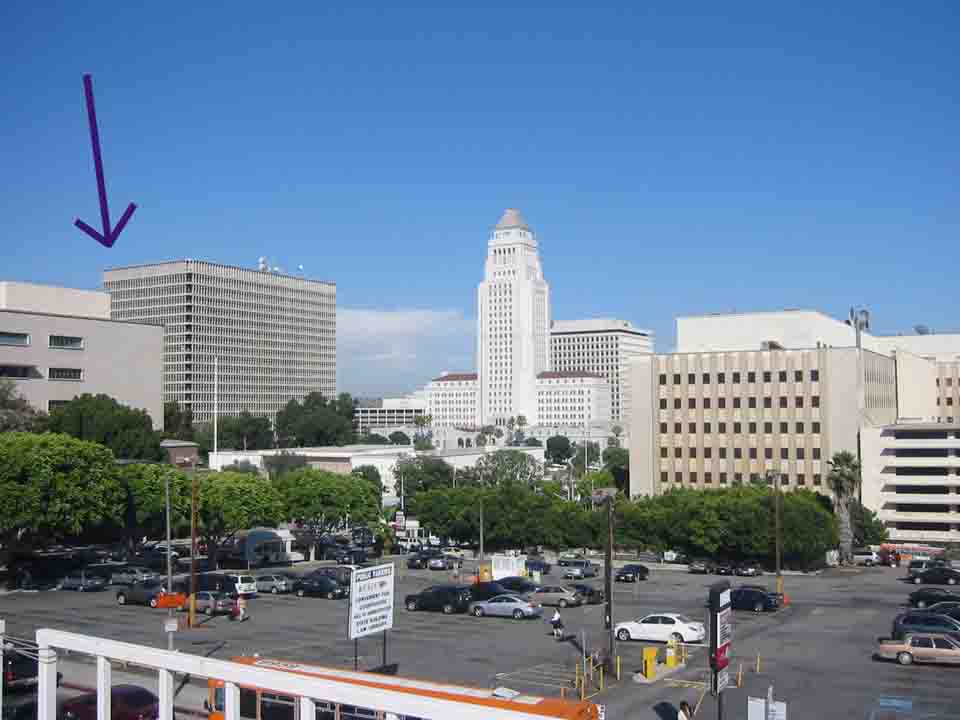
The arrow points roughly to where I sat around for the entire day on the 11th floor of the Clara Shortridge Foltz Criminal Courts Building. I was making myself available to serve on a criminal trial jury . They didn't need me.
They also serve who only sit and wait

The white pointy building in the middle is Los Angeles City Hall.

Budget Rent-a-Car 626 831 5244 I took this picture on the drive home. A new low point in real estate advertising in Pasadena. For that price it's probably a condo. I enhanced the sign a bit to make it easier to read.

(Click on either picture for a larger view.)


In the evening Leslie and I watched Penn Gillette's (completely legal) movie The Aristocrats. I loved it. Leslie left the room after about 5 minutes.

CLEAN Aristocrats Video: Here's a the trailer suitable for viewing anywhere. (No actual dirty words or concepts. Lots and lots of innuendo.)

Here's the Aristocrats website.

DIRTY Aristocrats Video - WARNING Do NOT watch the following clips at work, with children or in the presence of moralist prigs.
Dirty Clip Number One
Dirtier Clip Number Two (Card Trick)
Dirtiest Clip Number Three (Gilbert Gottfried at the Friars, the climax of the movie)

A scholarly paper on the legal history of the word "Fuck"
(I found this link on WFMU blog.)


California
Movies

Thursday, June 01, 2006

In which David Enjoys a Rite

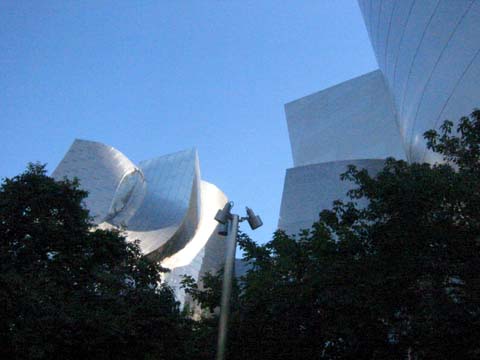
Disney Hall preview concertWednesday night, sitting in the fourth row of Disney Hall, I heard the Los Angeles Philharmonic, conducted by Esa-Pekka Salonen, perform Stravinsky's Rite of Spring. In 3 seasons in the new hall I've heard them do it about half a dozen times. I'll happily hear it a half dozen more.

I won't play the critical game of comparing performances or interpretations, but this has become one of my peak audio experiences - like playing a favorite CD as loud as I want. If you get the chance to hear this group play this music in this hall, take it. It'll make your hair whizz back. (I suppose you ought to regard whizzed hair as a positive thing. I know I do.)


Disney Hall Mountains in the distanceIt's more than just the wonderful acoustics - it's how the orchestra has learned to use those acoustics. While the loud passage make it exciting - the soft places make it magical. (A muted trumpet duet being the most magical of all.)

When I told Leslie I was going to hear yet another Rite of Spring, she reminded me how I diss the people who want to hear Beethoven's Ninth over and over. (I've had to sit through TWO performances of that in 4 years - which is two too many. Neither was in WDCH.) Whatever floats their boat.

The L.A. Phil Rite of Spring performances are an inspiration to me - of how well a composer can use a full orchestra - and of how well an orchestra can take that and run with it. Beethoven's Ninth, unfortunately, just reminds me of things a composer should avoid.

Another Mixed Meters post which deals with uses for the Rite of Spring.

If you think Beethoven's Ninth should be 24 hours long, this Mixed Meters post has a link you'll love.

The Video Corner

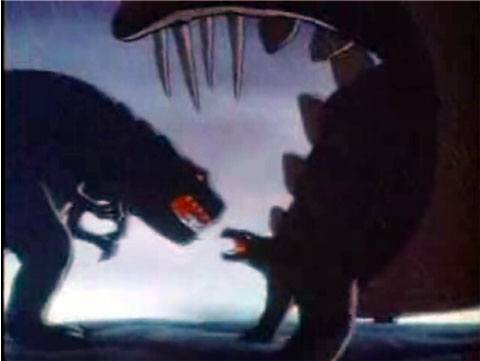
Thirsty Dinosaurs on paradeI can never hear Rite of Spring without seeing in my mind a line of exhausted dinosaurs crossing a desert. This is probably because my first exposure to the RoS, decades ago, was through the movie Fantasia.


Dinosaurs Duke it OutBut hey - some of the profits from Fantasia probably made their way into the Disney family donations for the WDCH acoustics. You can implant those same visions into your brain right this minute if you're not too worried about crimping Disney's future profits.

Click here (part one, in space)
or here (part two, volcanoes & pterodactyls)
or here (part three, dinosaurs trekking)


(Here are similarly posed dinosaurs in fossil format at the Los Angeles County Museum of Natural History where Leslie works in the worm department. This particular picture came from HERE.)


And three short clips that are no longer part of Fantasia's Beethoven Pastoral sequence - was the depiction of this little character racist? Is it racist now? One Two Three


Music Reviews
Music Video

Wednesday, May 10, 2006

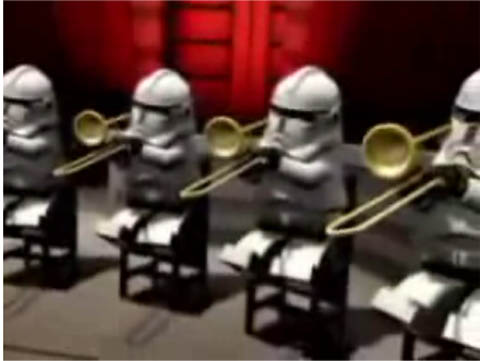
Star Wars Orchestra

Click here. Some conductors find that using a baton makes the players more attentive.


Music Video

Friday, March 24, 2006

On the Religion of the Past and the Future

Here's a link to what I wrote during the Mixed Meters Dark Ages about three religious movies: The Blues Brothers, The Life of Brian and Passion of The Christ.

Here's a link to a video mash-up someone did of the climaxes of those last two movies. WARNING - True Believers should not watch this - and the rest of you won't like it either. But it does have Eric Idle singing, so it counts as a Music Video.

Mixed Meters Junkie "S" sent in this link - a compendium of news stories about people who are awaiting the imminent end of the world. These are probably your neighbors and certainly the people who run our country. S liked the Talking Fish story which he connected to Monty Python.


Why are people who see the face of the Virgin Mary in a cheese sandwich regarded as believers, while people who see naked ladies in advertising ice cubes are regarded as perverts. Various explanations and comments about believing what you don't see are here or here or here (the last is a free term paper fnord our student readers.) Poor Wilson Bryan Key - all he really did was carry the thought that someone is trying to manipulate us just a little too far.

Click on the ads for a larger, more enjoyable experience.


Religion Music Video Media Movies