Showing posts with label David's favorite music. Show all posts

Tuesday, April 22, 2014

Rudy Schwartz Project: Winter Dance of the Koala Sperm Harvest

In my previous post I mentioned Joe Newman of the Rudy Schwartz Project.  Then, a couple days ago I discovered a copy of the new RSP album Winter Dance of the Koala Sperm Harvest in my mailbox.  Apparently the album has not been formally released yet.  So let this be a lesson to you: if you want to be the first on your block to hear his music mention Joe on your own blog.

You will be able to download the new album from this large corporation or from this other large corporation.  Older RSP CDs are still available from this small company.


This album has all the hallmarks of any good RSP release:
  • clever and amusing musical parody
  • up to the minute political outrage
  • encomia to or mockery of actors with familiar faces 
  • references to sticking things into people's butts
  • bits of fun ugly new music or avant-garde jazz
  • cultural references you can't quite identify
  • little bits of old movies or commercials
  • clever lyrics you can't believe anyone has balls enough to actually sing
And what other album dares to ask, in its opening track, whether you'd prefer to hear Schoenberg or Neil Diamond?

Clearly, when it comes to having an ear for imitating musical styles and using them to lampoon the buffoons who run the world in order to screw little guys, Joe Newman is a worthy successor to none other than Frank Zappa.  I bet he wishes more people agreed with me.

Other cuts on this album which deserve mention (in my opinion):

  • The Guy From the N.S.A. (a calypso tune; the chorus goes "Fuck the guy from the NSA")
  • Le twist gnossienne (Erik Satie as dreamt by Dick Dale)
  • Winter Dance of the Koala Sperm Harvest (a new genre: Tchaikovsky ballet parody)
  • A Better Tomorrow (clearly the best use of the word 'not' in any song ever)

Here's a sample track from WDotKSH. It's called In Cucamonga - video imagery by Zontar.  Yes, that's Jesus himself on vocals.


Here's a picture of Mount Rudymore showing the Rudy Schwartz Project pantheon - Don Knotts, Olan Soulé, Abe Vigoda, Bob Eubanks and Ernest Borgnine.  (click to enlarge)


You can like The Rudy Schwartz Project on Facebook.  You can listen to some of their albums on Spotify.

Wednesday, July 31, 2013

The Rudy Schwartz Project

Back in the day Mixed Meters had a sidebar feature called "David's Favorite Music".  This listed all the posts I had written about music and musicians I particularly enjoy.  The list was short, eclectic and incomplete.  Eventually I removed it to simplify the blog layout.   You can still read all those posts via this link.

The top three omissions from the list - in no particular order - are Astor Piazzolla, Glenn Gould and The Rudy Schwartz Project.  Astor and Glenn have stopped performing these days so they won't mind waiting for their articles.   Meanwhile the RSP is more active than ever.  There are new albums, YouTube videos and even a Facebook page.

Here's a Rudy Schwartz Project tune I really like  - Stumpy (from the album Delicious Ass Frenzy).  It's about a bad-ass monkey with no ass.  I like the cool mistuned piano vamp.


Today's wonderful world of social media has brought me into contact with the fecund brain behind The Rudy Schwartz Project, the mysterious, talented, uber-creative Joe Newman.  Joe recently volunteered to remix a recent piece of mine, Not A Happy Camper.  (Listen to the improved version here.)  I'm finally writing this post as a feeble thank you to him for the excellent work he did on that project.  Maybe this extra publicity will get all the Mixed Meters readers to buy an RSP album.  That would be three more albums sold.

First, however, I think you must have questions you want to ask.

Your first question, I bet, is "Who is Rudy Schwartz?"

Answer: I don't know, but the Project named after him began in Austin Texas sometime in the 80s.  That was a time when independently produced, not particularly commercial music was distributed via the high-tech medium of cassette tapes.  I had several of my own tapes about that time and I suspect Joe and I must have traded.  How else could I have gotten my copy of Don't Get Charred, Get Puffy on cassette?  It's dated 1991.

Listen to one of my favorite RSP tunes ever: An Orange Is Nothing But A Juicy Pumpkin.  You can also listen to The Creation Science Polka.

Read an interview with Joe Newman discussing early period Rudy Schwartz.

Your next question, I bet, is "What happened after the early period?"

Answer: After the early years, Rudy and Joe disappeared for a long time.  There were no more Rudy Schwartz Project albums.  Then, suddenly, I think in the mid 2000's, Joe reappeared, living in Montreal.  He began releasing new albums fairly regularly.  The most recent is called Full Frontal Klugman.  Highly recommended.  Here's a fine tune from FFK entitled "You're Not Rondo Hatton"  (Rondo Hatton was an actor with a strange face and an apparently unintentionally musical name.)


Time for your last question. I bet you want to ask "Why do you like this music?"

Good question.  Here are some reasons:

1) The music of The Rudy Schwartz Project is politically topical.  It takes on some of the most destructive forces in American politics point blank using both outrageous humor and forthright anger.  Early RSP called out demagogues like Ronald Reagan, Phyllis Schlafly and Jimmy Swaggart.  Recent tunes excoriate George W. Bush, Dick Cheney and Sarah Palin.

Sarah Palin Pussy Juice:


Carry Me Back To the USA:


2) Joe Newman has an incredible talent for musical parody.  From popular music of the 1930's, or 50's rock 'n roll or 70's pop tunes.  He's covered John Denver and Bruce Springsteen tunes and the most off-the-wall version of Georgy Girl ever.  There are probably a bunch more covers he has done that I don't even recognize.

Road Trippin' With Waldo:  (Waldo Hamm is the RSP's mascot - a sock puppet reindeer.)


3) There is a keen element of cultural commentary.  Besides Rondo Hatton, there have been RSP tunes about Ernest Borgnine, Bob Eubanks, Nancy Kulp, Don Knotts, Doodles Weaver, Florence Henderson and the Dallas Cowboys, to name but a few.  Some of these are even complimentary.  The cultural reference aspect of Joe's work has been expanded by his move into video - as any of these examples in this post should easily prove.

Here's a redone television commercial called Colgate Clean:


Theme from "Sweet Movie":


4) Most importantly, Joe Newman is a creative, clever and curious composer who writes interesting, inventive and intriguing music. Aside from the subject matter he chooses or the pop cultural references he makes or the lyrics he sings, his music itself is a delight. Composers who use unexpected harmonies, sound collages, abrupt melodic turns and unpredictable changes in orchestration ought to be more common than they are these days.  When music gets pretty far out, I tend to like it.  I like this music.

A Nice Selection of Hasps:


In many ways I'm jealous of Joe Newman's talents as a composer.  He has combined cultural commentary and creative music making in a way that I would love to do myself, but find I don't have the necessary talents.

Finally, I have a question for you.

Can you name another composer who has combined these same elements: politics, parody, cultural commentary and cutting edge music?

Yes, the correct answer is Frank Zappa.  Many people have commented on Joe's debt to Zappa, even Joe himself.  The aspects of cultural parody, political commentary and cutting edge music which are well accepted in Zappa's music have not found many adherents in popular music since his death.  Those characteristics have been preserved and uniquely extended in Joe Newman's music.  I think he should get more recognition for it.  Any Zappa fan ought to really check out The Rudy Schwartz Project.  You'll be glad you did.

Frank:


Waldo Hamm Tags: . . .

Saturday, February 06, 2010

Sergey Kuryokhin - pianist of anarchy

Sergey Kuryokhin passed away in 1996 at the age of 42.  He was an avant-garde improvising pianist from the Soviet Union.  Apparently he did a lot of other things and was quite well known in Russia.

Years ago I purchased Kuryokhin's solo album Some Combinations of Fingers and Passion.   Each of the four track titles begins with the word "combination"; for example A Combination of Boogie and Woogie.  The first cut, A Combination of Passion and Feelings, is my favorite.  Another cut based on the Dave Brubeck tune is called A Combination of Power and Passion (Blue Rondo a la Russ - a Tribute to Dave Brubeck).  I don't remember why I originally bought the disc but I do remember how it amazed and impressed me.  It still does.  (You can buy it online here.)

Some Combinations of Fingers and Passion reveals an obviously classically-trained artist who is free-associating his way through the musical styles of several centuries.  He does everything with tremendous good humor, a complete lack of self importance, seemingly limitless talent and a large well-spring of pure creativity.  His styles range from Mozartian classicism through the most excessive uber-Romantic schmaltz with episodes of pop musics from different eras.  All of this is spiced with bursts of the most atonal free jazz you or Cecil Taylor could imagine.

Sergey Kuryokhin - Some Combinations of Fingers and Passion


There is information about him at kuryokhin.ru the website of the Sergey Kuryokhin Modern Art Center in St. Petersburg.  The center organizes SKIF,  the Sergey Kuryokhin International Festival, held yearly in Kuryokhin's memory.  Here are several interesting excerpts from their biography page about Kuryokhin:
In 1984 he formed Pop-Mechanika Orchestra - a band, a concept and a philosophy. The band, which could be anything from a modest trio to a full blown multimedia extravaganza complete with a full symphony, a brass band, a rock group, a circus, a zoo, a gypsy singer, and whatever else his fantasy could bring up at the moment, subsequently toured most of the world.
Pop Mechanics was probably perestroika’s most exotic fruit, a big band melding all the typical cliches from dozens of musical styles – industrial music, free jazz, hard rock, operettas, contemporary music, King Crimson, Glenn Branca’s massed guitars and so on and on – into a sometimes sloppy, sometimes feverishly driving pileup. The “pre-Leningrad Cowboys” visuals were an inseparable ingredient part of the concept. They included live goats, pigs, tigers, chicken, dogs, donkeys, monkeys, snakes and ponies onstage, surrealist dresses, and when Pop Mechanics was on its peak in the late 80’s Kuryokhin managed to have a folk ensemble, a KGB employees’ choir, a classic chamber orchestra and an army truck performing simultaneously in addition to the big band itself.
"We hadn’t even properly heard the music [from the  west], only read about it. For us Western industrial music, Einsturzende Neubauten and all the rest were like a myth, just the same way that it was a truly mythical event when John Cage came to meet us in Leningrad in 1988. Cage’s thinking had influenced very much the concept of Pop Mechanics, especially his idea of all sounds having equal right to exist. Thus we always wanted to have both human and animal sounds in the live show”, [Pop Mechanics' member Sergei "Afrika"] Bugaev says now.
Sergey Kuryokhin at two pianos - The Ways of Freedom

Of the discs I own, besides the ones for solo piano, there are performances by Kuryokhin with small groups and with big bands.  One strange disc (I think it's called Introduction in Pop Mechanics; it's number 3 from the four-disc set Divine Madness for which Leo Records annoyingly does not provide a downloadable program booklet) is apparently played with one hand on an organ and the other hand on a sampler keyboard.  It goes for over an hour with only one short contrasting section in the middle.  In other words, the sudden twists and surprising turns which I like so much are not there.

He did a lot of different things - I said that before.  YouTube might be the best place to get an overview: you can search for Курехин on You Tube.   You'll find many interviews in Russian plus clips of movies for which he wrote the music.  A BBC documentary about Pop Mechanica's trip to Liverpool in 1989 (it's in English; Part One and Part Two) really gives the over-the-top kitchen-sink anything and everything feel of his performances.  I particularly like the scene where Kuryokhin is singing into a microphone while being beaten about the head and neck with bouquets of flowers.

Contemplating these mad anarchic happenings in small doses from a distance is refreshing, especially since anarchy is so very out of favor in American music lately.  I doubt I'd care to attend a Pop Mechanica extravaganza or any sort of happening at all these days, but, hey, what's wrong with watching a little anarchy, I always say.  Back when happenings were happening in the U.S. their creators weren't known for extreme musical stylistic variety in the way Kuryokhin seems to have embraced so naturally.  Try searching Google for the phrase "David Tudor plays jazz".

The craziness aside, it is specifically Kuryokhin's solo piano playing which I find inspiring.  Without that, there would be no point in my writing this article.  Alas, there seems to be very little of his solo work available on YouTube.   Here's a YouTube video from the solo piano album The Ways of Freedom, a cut called The Wall Kuryokhin:


The picture above of him playing two grand pianos is from the same album.  On the record jacket it says:

Leo Records is grateful to all those people who had the courage to smuggle out the tape from behind the Iron Curtain.
Some of the playing has a Conlon Nancarrow-ish feel.  Kuryokhin plays blindingly fast on a tinny sounding instrument - or maybe the tape speed has been messed with.

His solo playing also attracts me because it is so completely unaffected by the "jazz swing" pandemic from which improvised music often suffers.  These days, in certain types of music, swing feel is omnipresent, like it was handed down from God.  Modern jazz seems hopelessly addicted to it.  I'm often annoyed when players can't turn it off.   Kuryokhin almost never turns it on - although other players on his albums do.

Sergey Kuryokhin - Absolutely Great!

The seven-disc album Absolutely Great! is fascinating, full of wonderful music.  There are three complete concerts recorded in 1988 in Northern California.  Each concert is on two discs; the first of each pair is mostly Kuryokhin playing alone and the second disc is ensemble music.  (The last disc is a less thrilling commercial release by Kuryokhin and Henry Kaiser.)

Kuryokhin's solo playing surprises and delights me.  It leaves a very positive feeling.  Of course, as with any improvisations, quality varies; you take each moment as it comes.  Inevitably, some moments are better than others. I like the mix of strangeness and vituosity.  To say that his music is from another country doesn't begin to describe it.  Rather it seems to me like it comes from a different planet.

I've added the album Some Combinations of Fingers and Passion to David's Favorite Music which you can find in the left side-column of Mixed Meters.  It's my woefully incomplete list of things I like to listen to a lot.

I don't add music to that list because I think other people will necessarily like it or because I think it will endure through the years.  There are other blogs chasing that fool's errand.  The reason I put music on my favorites list is because it inspires me to create my own music.  That is the highest tribute I can imagine offering to another musician.


Other Mixed Meters' writings touching on improvised music:
Art Tatum Plays Live - June 2008
Mingus Epitaph (if only to see a picture of W playing a guitar)
The Golia LaBerge Ocker Trio
A New Rhapsody in Blue (Marcus Roberts)
A Tradition of Experiment in Los Angeles which comes complete with a collection of reviews, programs and fliers from the late eighties and early nineties.  Get it in pdf or text.

Sergey Tags: . . . . . . . . . . . . . . . . . .

Sunday, December 27, 2009

Could Terry Riley's In C Be Accepted As Classical Music

Minimalism, as a musical style, has produced a clubby group of composers. Earlier this year some of them held the Second International Conference on Minimalist Music. In blog posts from their conference I learned of a new book about one particularly classic piece of minimalism: In C by Terry Riley.

This thin book, Terry Riley's In C by Robert Carl, is interesting mostly for the information about the composer's early life and the events surrounding the creation, performance and initial recording of his famous 1964 work. Carl's musical analysis and reviews of various recordings are less involving.


In C is a genuine classic piece of music of our time. By "our" I mean baby boomers. In those days when many of us encountered this style of music for the first time ("minimalism" wasn't the default term yet), it seemed like an endless open vista wherein anything might be possible.

In C was hugely important in my own personal development as a musician. You can no longer hear this in my current music but it was quite obvious back in my "first compositional period" (before I temporarily gave up writing in the early 90's).

In the 70's, when I was studying weird new music at CalArts, I used to come home at night exhausted from music by the likes of Stockhausen, Cage or Carter and relax by listening to the original Columbia recording of In C with the little electronic whoosh marking the split between side A and side B. Some evenings I listened to it all the way through twice or three times, all 40-some minutes of it.

Of course being a little stoned didn't hurt - but wasn't required. The music had a positive, heady power; so much energy. It carried me along. It was completely different from the dry new music which dominated my graduate education. More importantly I was totally amazed by two important qualities of In C: its structural simplicity and its social egalitarianism. I still am.

SIMPLE

In C is actually a kind of orchestra piece. Riley suggests about 35 players as the optimum number, although it has been done with many fewer or many more. In an interview he said that it might be played solo if the right player could be found. Good luck with that. It works well as a chamber piece for seven or eight very busy players.

With big ensembles In C challenges the notion that large symphonic works need huge over-notated scores filled with inaudible precision. The entire score fits on one letter size sheet of paper. A conventional orchestra score of similar length might have as many as 200 densely packed pages.

Obviously this seems more important to a person who has spent his entire career dealing with printed musical notation than it does to you. If such simplicity had become the norm rather than a single exception I might have had to find myself a different line of work.

Riley's composition allows only a few written notes to produce a highly complex texture every bit the equal of more precisely written pieces. It comes out differently every time - but it is never so different that you can't identify it immediately. This simplicity is a worthy and all-too-rare quality of contemporary music.

Originally the instructions on how to play that one small sheet of music were handed down verbally from musician to musician. Years later Riley added some text instructions codifying the performance practice - although he still seems pretty loose about the rules.

Here is the full orchestra score of In C. You can download a better looking pdf along with the instructions from Otherminds.


EGALITARIAN

The other important, mind-blowing idea which In C represented to me is its complete revolution in the social structure of the orchestra.

In a conventional orchestra the most-important person (i.e. the "conductor") dictates behavior from above. He stands alone, elevated on a podium. Meanwhile, down among the players, there is a formal pecking order. For example, the principal players, the ones who get the solos, are ranked higher than the garden variety section players. They get paid more too.

Of course this hierarchical arrangement is endemic throughout our society. Most people experience it constantly - at work, in school or in a family. Orchestra hierarchy bothered me a lot when I was a student. It still does, but not so much.

Riley has constructed In C so that the artistic responsibilities of the conductor - plus a large chunk of the composer's job as well - are distributed among all the players. His simple rules allow great freedom to be spread among many equal participants.

The performers stay together by listening to a steady pulse instead of by watching a conductor. This is not unlike playing with a metronome. Each player makes a continuous stream of artistic choices, unprecedented freedom for an orchestral musician. Riley stresses that all the players must listen carefully to properly fulfill their responsibilities. Their decisions matter to the final result.

Using only musical notes and musical structures In C eloquently speaks against the orchestral chain of command. It's my hope that performances of In C preserve and promote these laudable political and social principles.

These days In C has a certain dated sixties aura of utopian hippy anarchist communes about it. Cool, huh? There's no reason that feeling can't invade the world of classical music once in a while.

Terry Riley in 1978 - Portrait by Rob Jacobs
Very large ensemble performances of In C, which are often the very high profile ones as well, seem to lose this political message. The argument is made that some hierarchy must be introduced to avoid cacophony.

A recent celebration at Carnegie Hall celebrated the 45th anniversary of In C's composition with a large ensemble (about 70 players) which, according to the N.Y. Times, was led by a:
“flight pattern coordinator,” [who] used flash cards and hand signals to shape the sprawl.
Mark Swed, in his review of a performance by 124 musicians from CalArts (at Disney Concert Hall in 2006) wrote:

David Rosenboom, the violist on the historic first recording of the piece, conducted. ... Rosenboom more carefully molded it, indicating when sections should begin changing figures lest so large an orchestra seem chaotic. ... When the longest and most harmonically complex figure (No. 35) dominated, Rosenboom emphasized the brass, and the score sounded like the end of Wagner's "Das Rheingold" writ large and Postmodern.
In 2000 Michael Tilson Thomas conducted a performance by the San Francisco Symphony to which anyone could bring an instrument and join in. Sarah Cahill, in her review of the concert, wrote:

His actions were absolutely antithetical to the democratic concept of the piece.
Instead of using conductors or flight controllers or referees to control a too-large group, wouldn't it be simpler to find a solution which respects the essential "every player is equal" theme. You could tell all the players to limit their playing by a certain percentage. If the number of musicians is double the optimum number, tell them to play only half the time. Simple. Even simpler: if you insist on doing this piece with too many players, you should be prepared to accept chaos. What's wrong with a little chaos? Either way, the decision of who-plays-when remains an egalitarian one. Each member of the ensemble gets an equal say and the social statement of In C, the part I find meaningful, is preserved.

Terry Riley recent picture I fantasize that someday In C will be programmed on regular orchestra concerts. Yes, getting this piece into the standard repertory is a long ways off. If it happened, In C would change from a "minimalist classic" into an actual piece of classical music. That would provide strong evidence that classical music has some life left in it.

A chamber orchestra would be just the right size. Before the intermission the program could be, maybe, a Rossini overture and a Mozart concerto. And the second half would be a 35-minute performance of In C employing all the performers from the first half. Great concert! Of course, during In C the conductor should sit in the ensemble and play an instrument, provided he or she is capable. Otherwise tell the conductor to sit in the audience.

Now in 2009, with the history of minimalism nearing an inevitable end, conventions held, books published, courses taught, I can see how unique In C really is. Other orchestral music of recent decades has remained complex and hierarchical by comparison. No tradition of ultra-simplicity has appeared among other composers. Quite the opposite. Nothing about orchestra music - or music composition in general - challenges the structure of society. Quite the opposite.

By its very uniqueness and originality, In C deserves to be widely performed and discussed. It could easily be added to the classical canon. That revered list of works would benefit from adding this bright spot of sixties counterculture to the morass of 19th century romantic orchestral muck.


Here's an LA Weekly interview with Terry Riley.

Listen to WNYC's New Sounds show, interview with Terry Riley and David Harrington.

A print interview entitled "A Stoned Mozart?" with Terry Riley and David Harrington

You can read chapter one of Robert Carl's book here.  For me, re-reading it made me want to relisten to the original recording of In C. I hadn't heard it in a very long time. But I couldn't find my LP from back in the Seventies. My friend Paul Bailey once told me that it wasn't a good performance. I scoffed. I ordered another LP via the Internet, an LP rather than a CD so I could hear the whoosh - the electronic sound which abruptly reminds you to turn the record over. I listened to it once. Paul was absolutely right - the performances sucks. You can listen to two recent chamber performances led by Paul here.

I performed In C many times, including at one particularly memorable I.C.A. concert in 1978 with the composer himself in the ensemble.

Other Mixed Meters attacks on the classics:
Finally - I've added In C to the left-column list of David's Favorite Music, a long since forgotten and still incomplete feature of Mixed Meters. There are a number of my absolutely favorite composers who deserve to be included. Someday.


A Harvard Business School study looked at job satisfaction. Orchestra players came just below prison guards. Chamber musicians came in at number 1. What’s the difference? The presence of a conductor. Conductor Ben Zander quoted here.

Tuesday, September 09, 2008

Vocal Sampling

If you think this post is going to be about computerized musical instruments called samplers, cousins of the synthesizer which play back little bits of real sounds (like maybe people singing), then you've got a big pleasant surprise ahead of you.

Vocal Sampling - Cambio de Tiempo
In this case Vocal Sampling is an a cappella male sextet from Cuba who sing (and occasionally clap or whistle) entire fascinating salsa arrangements.


I'm no expert on salsa music - but I know what I like when I hear it. And I like this. All five Vocal Sampling albums live on my iPod. This music makes me feel good. (Fortunately I don't speak Spanish so I don't have to worry what they're actually singing about.)

Vocal Sampling - De Vacaciones

Imagine the early Mills Brothers singing uptempo music by Tito Puente.


One of the five albums was recorded live - as are some of the YouTube clips I've embedded for your enjoyment.

Vocal Sampling - Live in Berlin

Surprisingly I was very taken with their version of Hotel California - not because I like the song but for the guitar solo at the end.


As a side note I discovered that Hotel California really exists - it's in Palm Springs.

Hotel California - Palm Springs CA

Of course, the fact that all six singers are heavily amplified is essential for live performance. The poor guy who sings the bass part couldn't possibly project enough without a microphone. And clucking out the continuous clave rhythm seems like it would be very tiring.

Vocal Sampling - Una Forma Mas

This clip is a sung electric guitar solo. A tenor couldn't do this.


Thanks to my friends John & Kazi for loaning me three of the albums. I've give them back ... someday. All the albums seem to be available on Amazon although Akapelleando costs a whopping $61.99.

Vocal Sampling - Akapelleando

Here's Vocal Sampling's website. It says they'll be touring Germany this fall. The final clip is a (Cuban) music video. If anyone can explain what's going on, I'd appreciate a comment.


Vocal Tags: . . . . . .

Monday, December 03, 2007

David Ocker, Boy Music Critic

Don't be fooled, this post is actually about Domenico Scarlatti, whose music I will eventually compare to that of John Coltrane and Erik Satie. But the story really starts over 35 years ago at Carleton College in Northfield Minnesota. And it ends with the line "Once Upon A Time".

THE COLLEGE MUSIC CRITIC

Many of my most positive opinions about music were formed while I was an undergraduate at Carleton. (as opposed to many of my, um, less positive opinions (now well known to my three readers) which I developed while in graduate school a few years later.) Here's a picture of me on my first day as a Junior at Carleton. 1

David Ocker autumn 1971 Evans A in The Chair
To honor the positive accomplishments Carleton made towards educating me I send them token donations every year. In exchange they send me wall calendars so saturated with nostalgia that I instantly toss them out.

These days Carleton also emails alumni newsletters replete with something called "E-NEWS". Recently E-news announced that every issue of the school newspaper, The Carletonian, had been digitized and posted online at ArcaSearch.

I immediately did the most natural thing, I searched the archive for my own name.


It turns out that during my senior year I wrote a number of concert reviews and promotional pieces. I had completely forgotten all of them except one.

For example, I have absolutely no memory of the concert I was flogging in this article Band Concert on Pastoral Lilac Hill on May 17, 1973. Here's a picture of the Carleton Band (obviously not on Lilac Hill, but you can see me playing clarinet to the left of the conductor, framed by the wye of the tree.)

Carleton Concert Band 1973
The one article which hadn't escaped my memory was a review of the William O. Smith/John Eaton Lucas Lectures. Eaton and Smith - It Sounded Better From the Lobby on January 18, 1973. It was very positive article in spite of the subtitle. I also wrote a promo for those concerts: Eaton, Smith, New Music on January 11.

I'm sure that event has stayed in my memory because meeting clarinetist William O. Smith really did change my life. I spent the next couple of decades trying to be an avant-garde clarinetist. I never saw Smith again - but I did continue to explore the boundaries of clarinet performance and even played his solo clarinet music from time to time (for example, check out the program at the end of this post). He deserves a long overdue thank you.

Here are three more reviews.

Contemporary '73 (music by Bartok and Crumb, February 15, 1973)
It's Too Bad They Wore Tuxedos (The American Woodwind Quintet - Nov. 11, 1972)
I Adore Philador (March 8, 1973)

Reading these brought back a flood of useless memories.

DOMENICO SCARLATTI KEYBOARD SONATAS
2

In the review of the Philador Trio (playing 18th century Italian baroque music) I was clearly out of my element. But this paragraph stood out from the antique typesetting:
In my biased opinion, the 490 odd Demenico (sic) Scarlatti harpsichord sonatas are the most enjoyable pieces ever written (and I will defend myself against all who disagree, but I will never deny that I am right). It is not odd, therefore, that I thought that the performance of five of these sonatas was the high point of the concert. No more discussion is necessary.

Two realizations made reading this bit of boyhood music criticism fascinating:
  • My enthusiasm for Scarlatti's keyboard sonatas has remained the same (or maybe even increased) over 35 years. 3
  • My propensity to make grand sweeping generalizations of what constitutes good (or bad) music has remained the same (or maybe even increased) over all these years as well.
My initial exposure to Scarlatti was probably from the four sonatas on the album The Well-Tempered Synthesizer4. As a beginning piano student at Carleton I advanced far enough to play a few myself, naturally having my mind stretched while happily banging out some of the cluster harmonies on a piano. And I acquired a 3-LP set of Fernando Valenti playing several dozen sonatas, noting sadly that he had recorded hundreds of others which I could not find.

When I got to CalArts Valenti, who was on the faculty, gave an all-Scarlatti concert. He worked hard to bring the emotions of the pieces out - way out, nearly collapsing in "tears" onto the keyboard of his harpsichord at the end of one poignant sonata. Ever since then that performance has defined the phrase "milking it" in my mind.

Years later the first complete set of Scarlatti sonatas by Scott Ross became available on 33 compact discs.
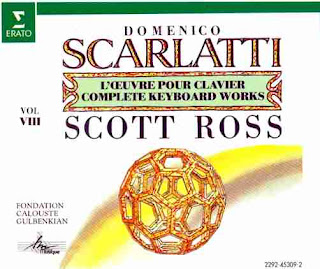
A CD cover from complete Scarlatti Sonatas by Scott Ross
I found out about the set when the local Pacifica station KPFK devoted all their daylight airtime during a holiday weekend to broadcasting the whole thing. I listened intently. The presenter was William Malloch (here or here or here for bits of info) who rationalized the broadcast to the audience (and perhaps to the station management) as a tribute to Ross, an early victim of Aids, rather than as an opportunity to experience some great music. Whatever. It worked.

The form and style of each sonata is remarkably consistent throughout the cycle. A modern composer could never imagine writing so many similar pieces. The closest modern equivalent, if you ignored the issue of lyrics, might be a prolific popular songwriter.

Listening to the entire Scarlatti set made me realize that the 555 sonatas form one huge piece of music, a single hours-long work. The sonatas are so similar that each becomes just a moment in a huge meta-structure, not "movements" (as in a symphony) but more like "choruses" (as in a jazz solo.)

Multiple Scarlatti sonatas become a bubbling stream of constantly fresh ideas in which twists of melody, harmony and rhythm are always floating past. The underlying sonata structure provides some cohesion. The overall effect reminds me of John Coltrane soloing on, say, My Favorite Things - putting out idea after idea while the rhythm section vamps happily in the background.

If you consider the massive length of the combined Scarlatti sonatas they can be compared to another keyboard piece, Vexations by Erik Satie. Vexations is a short gnarly dissonant bit of piano music which the composer instructed was to be repeated 840 times during a single performance.5 Of course the actual musical content couldn't be more different. Scarlatti is tasty and rich - a true physical pleasure. Satie is just a few seeds and stems, memories from the bottom of the bag.

I also own a complete recording of all the Haydn symphonies conducted by Antal Dorati. This represents about the same quantity of music (and same number of discs) as the Scarlatti. The difference is, as you progress from symphony to symphony chronologically, you can hear Haydn working out his ideas, changing over time. He created the form by trial and error, adopting and discarding things. This is completely different than the way I perceive the Scarlatti. I'm not suggesting a value judgment between these two massive bodies of music. Rather I'm making an observation about the purposes, personalities and careers of the two composers as viewed abstractly through the artificial lens of nearly three dozen compact discs each.

Finally, I've noticed that my interest in Scarlatti does not change according to the medium or performer to which I listen. My iPod currently has four different interpreters - Ross, Valenti, Horowitz and Carlos - on harpsichord, harpsichord, piano and Moog. I enjoy all of them.

My affinity for Scarlatti is directly to the music itself. There is some ineffable, magical quality of his writing which resonates naturally with me and my tastes andmy preferences. It's a wonderful thing - which I can't really explain - and which I don't really understand.

NOTES AND LINKS

1 Note the chair I'm sitting in. Here's the same guy (me) sitting in the same chair 20 years earlier:
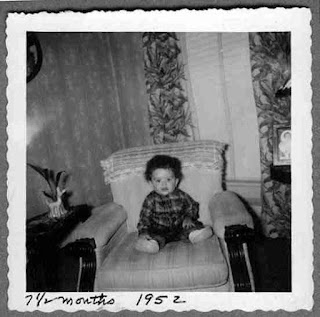
David Ocker - age 7.5 months (1952) sitting in the same chair
This was my Grandmother's chair. I wonder if it is still at Carleton, passed down from graduates to undergraduates year after year since 1973 - and hopefully cleaned or reupholstered on occasion.

2 The Complete Scarlatti Sonatas performed by Scott Ross on Warner Classics here. The Wikipedia entry on Scarlatti indicates that two more complete sonata cycles are in production, one on harpsichord the other on piano.

The Scott Ross wikipedia link.

Pdfs and funky sound files of a bunch of sonatas available at the Werner Icking Music Archive.

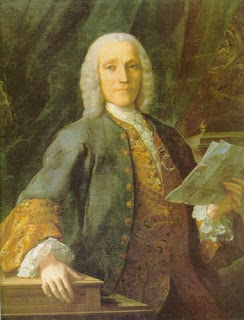
Domenico's picture came from here where you can find Midi files of all the sonatas.

3 Here's another Mixed Meters article about a college-era favorite composer about whose music my opinion has since changed.

4 Listening to the Well-Tempered Synthesizer album for the first time after several decades was a real trip for me. At first I was shocked by the "antique" analog synthesized sounds. But after a short time my disbelief was suspended and I relived a perfectly wonderful experience. I also realized that my use of stereo effects in my current music probably ultimately derives from their use in the Switched On albums.

5 Personally I think Satie was joking when he wrote the instruction to repeat so many times. The piece is no more scrutable after the last repetition than it is after the first. Someday I should write about my experiences playing in two complete performances of Vexations. One of them was organized by composer Carl Stone and broadcast live over KPFK. Once upon a time KPFK was quite a wonderful place to experience interesting music. Once Upon A Time....

Domenico Tags: . . . . . . . . . . . . . . . . . . . . . . . . . . . . . . . . . . . . . . .

Monday, August 20, 2007

A New Rhapsody in Blue

I turned on the car radio last month to the strains of Rhapsody in Blue. Ah, I thought "I must be listening to KUSC, LA's (one remaining) classical music station." Rhapsody in Blue, for all its jazzness, is part of the classical repertoire. It seems to be played by every symphony orchestra and every piano soloist over and over, each performance pretty much identical to all the others. Audiences appalaud dutifully.

After a few seconds I realized this was no ordinary Rhapsody in Blue. Along with the "classical" bits it contained actual improvisation. And I was not listening to the classical radio station. This was being broadcast on the (one remaining) jazz station - which normally never plays Rhapsody in Blue (because they don't play classical music.)

California Skylights - with palms and pylons (c) David Ocker
This rhapsody had soloists soloing (yep, multiple soloists along with the pianist including a big part for the lowly banjo). The soloists were making things up, they were being creative and individual. The familiar segues were different. There were new fascinating harmonies in the piano part; chord substitution is not a classical music talent (any more). This pianist, whoever it was, was a master of twisting the familiar into the fabulous.

In between all this was a regular orchestra playing the familiar bits which sounded, well, familiar.

It was still going strong when I reached our driveway. I sat and listened, enthralled, until it was over. Turned out to be a Jazz from Lincoln Center broadcast. The announcer (some guy named Winston or Wilton) said the pianist was Marcus Roberts. I marched inside and immediately ordered the album, Portraits in Blue by Marcus Roberts.. Here's more info.


When the album arrived I was surprised to learn that there were two sets of musicians; the improvising musicians and the classical musicians were not the same. The performance was credited to "Members of the Orchestra of St. Lukes and the Lincoln Center Jazz Orchestra". I had naively assumed that there are plenty of musicians who could play both halves of this piece, the classical and improvisation. I guess not.


The music is a mix of jazz styles - the liner notes mention Errol Gardner and Thelonius Monk. There's a Mingus-like section. The final cadenza ends with a vamp right out of Leslie Gore. I guffawed when I heard that. Now, dozens of listens later and knowing full well that it's about to happen, I still laugh.


This arrangement of the Rhapsody gets various live performances.
Here's an excerpt from a recent review by Harvey Steiman in Aspen Times (about the Aspen Music Festival's survey of the relationship between jazz and classical music):
I­n a 1­998 p­erformance o­f “R­hapsody i­n B­lue” h­ere i­n A­spen, t­he j­azz p­ianist M­arcus R­oberts p­layed G­ershwin’s m­usic a­s i­f i­t w­ere r­eal j­azz a­nd e­xtended t­he c­adenzas i­nto full­s­cale j­azz s­olos. T­hat w­as i­mpressive. A­nd r­are.
And Marcus Roberts performed the Rhapsody in Blue last week at the Proms. Here are some notes. And here are some reviews.

In a BBC interview before the broadcast Roberts said:
It's been wonderful pretty much every time we've done it ... because people know the piece, so when you improvise on it they can follow what you're doing, even if it's fairly abstract, even if it's fairly spontaneous.

Sky Lights - two curvy lights (c) David Ocker
The live performance was less interesting to me than the recording since many of the solos reverted back to the orchestra players who played them really "straight". Well, it was a run-out concert. And of course the recording represents the best of several takes. I'd like to hear the Lincoln Center recording again - that seemed pretty wild.

It occurred to me that if many (or even a few) performances of classical music had this level of creativity in them - of even a small fraction of the creativity in this performance - I would not think of it as such a dead art form.

Other music in my current listening rotation (meaning on my iPod) have similar creativity within a classical framework:
What these have in common is that someone has taken classical music, or some aspect of the classical music style, and treated it creatively with new ideas and new elements. This is not re-creative work, as so much classical performance is these days. It is also not recreational entertainment product. It will not need to be rerecorded and reinterpreted.

However, this is stuff you'll need to think about while you listen. Afterwards too. And of course a grounding in the classics will help but it's not enough. Not nearly enough. If you already have fixed thoughts about the great works of music, then you'll need to think new thoughts in order to listen to these pieces. That, it seems to me, is what makes a living art form.


Clazzical Jassical Tags: . . . . . . . . . . . . . . .

Friday, January 12, 2007

David's Eight Favorite Things of 2006

Okay, so I'm 2 weeks late and 2 items short of a ten best list. And one of the items I did pick is artificial butter. You should be able to infer that not much gets me excited anymore.

Also, not all these things came out in 2006. But they did come to me in 2006 and that's good enough, I figure.

1. Mozart in Egypt

Mozart in Egypt album coverA strange and wonderful album that I bought used on a lark in a local record shop. Egyptian composers created music using familiar bits of Mozart. Although I don't understand much about Egyptian music, its very different timbres and tuning make exciting and startling contrasts with the music I do understand.

2. Os Piratas Do Karnak

Os Piratas Do KarnakI blogged about this album previously. A really tight rock band from Brazil led by Andre Abujamra - if I understood the words they're singing in Portuguese I'm sure the experience would be ruined.

3. Fools Paradise

Fools Pardise with your host Rex
Fools Paradise with "Your Host, Rex" is 2 hours of "unsung" fifties Rock & Roll records every Saturday afternoon on WFMU radio. "Unsung" as in "really obscure" "Unsung" sometimes as in "can't carry a tune". Scrunch up your ears and it can become just like modren avant-garde music - only lots lots lots more fun. Rex lists the official gamut of styles as "vintage rockabilly, R & B, blues, vocal groups, garage, instrumentals, hillbilly, soul and surf". Lousy website, alas, but years and years of shows are archived. Get listenin'.

(Disclaimer - I knew about and enjoyed Fools Paradise long before 2006 - but the music I hear on this show (and nowhere else) remains such a kick that it still seems new to me.)

4. Serenity

the movie Serenity - a shot of the ship, Serenity
A fast-paced little space opera with a real plot, actual acting, humor and plenty of explosions. Everything George Lucas forgot about making decent movies in his recent Star Wars blockbusters. But Serenity proves someone out there still remembers how to do it - please, won't someone send me more escapism like Serenity?

5. The Huntington Conservatory

the new conservatory at Huntington Gardens in Pasadena CA
The Huntington, right here in Pasadena, is a collection of boring artwork, inaccessible libraries and fantastic botanical gardens. Gardens Beyond Fantastic. Their new Conservatory, modeled after one in England, is a fine place to marvel at strange natural beauty. Honorable mentions to their cactus garden and succulent house.

6. Lio

Lio, a new comic strip in the Los Angeles Times, nearly wordless, about a young boy with a There's Something About Mary hairstyle, who consorts with monsters and ghouls in the most pleasant way. Here are two strips, not really typical, in which Lio is called upon to provide music to the liking of his demanding, fluffy white cat Cybil.
Lio a comic strip by Mark Tatulli
Click on the strips for bigger strips.

7. Flickr

Hey it's a website. I use a lot of websites. This is the only one that never seems to screw up, is well thought out, works as advertised, never loses an upload, and surprises me with features I didn't know I wanted. Check it out Blogspot, it can be done!


Some of my snapshots live on Flickr.


8. Soy Garden

Soy Garden

If you're about my age and weight then your doctor has probably also told you to watch your cholesterol, like by giving up dairy products. For example, butter. But I love butter.

And anyone who thinks the I Can't Believe It's Not Butter crap in any way shape or form resembles butter must be missing a few senses. Fabio, are you listening?

But this stuff, Soy Garden, tastes like butter and it even stays hard in the fridge. Alas, it has all of the calories of real butter, but none of the cholesterol.

Ten Best Tags: . . .. . .. . .. . .. . .. . .. . . . . . . . . . . . . . . . . . . . . . . . . . . . . . . . .

I Can't Believe It's Not Torture