Showing posts sorted by relevance for query guevara. Sort by date Show all posts

Monday, May 25, 2009

Che's Brand

I read this review of Michael Casey's book Che's Afterlife, the Legacy of an Image. Here's the image in question. It shows revolutionary leader Che Guevara. This is apparently the most reproduced picture in history:

Che Guevara t-shirt graphic from Korda photo
I decided to read the whole book because of a bit of fluffy advertising copy quoted in the review. It's for an Australian ice cream flavor called Cherry Guevara:
The revolutionary struggle of the cherries was squashed as they were trapped between two layers of chocolate. May their memory live on in your mouth!
Silly! But together with a picture of a violent long-dead Communist these words apparently have the power to sell sweet frozen dairy fat to hungry Aussies. Maybe that's because this picture is an icon, an icon that can be called to the service of either socialism or capitalism.

Cherry Guevara Ice Cream wrapper

This picture has been used on bottles of beer, condoms, bikinis, bubble bath and countless t-shirts. It has been part of Smirnoff vodka ads and fake Andy Warhol prints (which Andy claimed to be his own work anyway). The picture has been used by leftist politicians in Latin America and right-wing religious fundamentalists in the Middle East. In parts of Miami this is a picture of the devil himself.

Here's the original photo as taken by Cuban photographer Alberto Korda in 1960.

Guerrillero Heroico - Che Guevara picture by Alberto KordaThe facts of Guevara's life provide only a starting point for explaining the picture. After becoming famous in the Cuban revolution Che pretty much bounced from job to job failing to make good as a bank president, a prison commander or a guerrilla revolutionary. He tried the last gig both in Africa and South America finally getting martyred for his trouble. Today, in parts of Bolivia, he is known as "San Ernesto"

Casey quotes Jorge Castaneda:
If ever there was an illustration of the anguish evoked in sensitive and reasonable, but far from exceptional, individuals, at being affluent and comfortable islands in a sea of destitution, it was Guevara. He will endure as a symbol, not of revolution or guerrilla warfare, but of the extreme difficulty, if not the impossibility, of indifference.
Hasta la Victoria Siempre - neon Che Guevara
Che's Afterlife
shows how the picture has avoided contradicting itself into meaninglessness. Explaining what it does mean is no easy task.

Casey writes:
We have invested so many competing ideas and meanings into the concept "Che Guevara" that we can't collectively conceive of what it actually represents with anything near homogeneity
Later he seems to contradict himself:
It functions as the universal symbol for the act of following one's convictions.
Until Cuba joined the international agreement on copyrights the image was public domain. Now Che himself is licensed commercially just like Marilyn Monroe or Albert Einstein or any living or dead celebrity.

Che beer

Branding is a trendy buzzword right now. People are trying to apply this marketing concept everywhere and anywhere they can. Che's Afterlife wastes no effort discussing brand concepts.

Che Guevara has become a brand and Korda's picture is its logo. Nike is a brand with a swoosh as logo; McDonalds has golden arches. The guardians of these brands - Korda's and Che's descendants together with the Cuban government on one hand, corporate executives on the other - try to preserve its value and focus its meaning by controlling where their brand appears. They decide which contexts, products or events should be associated with their brand and which should not.

Here's a picture of Che Guevara bubble bath.

Che bubble bath
The very pose of Che in the Korda photograph - a somber man, looking slightly up and off into the distance, imagining a better future (or maybe dreaming of a soak in the tub) - is reminiscent of an important graphic from recent U.S. politics, Shepard Fairey's Hope poster. Here it is slightly modified.

Shepard Fairey's Obama Hope psoter - reversed
With the recent change in the U.S. government many people are hoping for a change in the brand image of United States of America. There's no doubt that intelligent, thoughtful pedantic people are bending Barack Obama's ears with suggestions on how to portray America now that the dark ages are ending. You can read some suggestions for Re-Branding America here. This picture comes from that page.

Obama wears t-shirt showing Che Guevara wearing an Obama Hope t-shirt
I found the Obama-Guevara-Obama t-shirt picture and the Hasta la Victoria Siempre picture (the neon Che) at This Isn't Happiness.

The photo of the Cherry Guevara ice cream wrapper (and many other Che-ish graphics) can be seen here.

A Wikipedia entry which documents Che Guevara in Popular Culture

The Che beer picture came from here. The Che bubble bath picture came from here.

Here's a documentary about the life of Che Guevara.

Che Tags: . . . . . . . . . . . . . . . . . .

Tuesday, March 31, 2015

Che Guevara and Ted Cruz

Here's a picture of two right-wing politically divisive U.S. Senators who happen to look a lot alike.


As things stand right now, the one on the left will be the next president of the United States, if only because he's the only person officially in the race.  I trust that's only a temporary advantage.

Here's another combination of very divisive politicians.


Same right-wing guy on the left - I did the best I could shoehorning him into the famous Alberto Korda image.  Red is a good color for a Republican.  On the right is left-wing revolutionary communist Che Guevara, possibly the most perfect example of a divisive political figure.

Guevara is known to some as only slightly less evil than the Devil or Adolf Hitler, nothing more than a mass murderer.  Elsewhere - like in rural Bolivia where Guevara was killed trying to foment class warfare - he's regarded as a Saint.  Fact is, both sides have good reasons for their characterizations: that's the most infuriating part of it.

I guarantee that today, nearly 50 years after his death, Guevara is much closer to becoming an actual Catholic saint than Father Junipero Serra was 50 years after he died in 1784.  Che has another connection with the Vatican: both he and the current Pope are Argentinian.

Here at Mixed Meters we're mostly interested in the famous photograph of Che Guevara, an iconic artistic visual meme of massive proportions, used over and over again for purposes even more varied than his reputations.

Two previous MM blog posts on the subject are called Che's Brand and Che's Image.   Check those out for some bizarre capitalist uses of the Che/Korda images.  The first one is a review of a book about the picture.  There's also A Combination of Jingle Bells and the Internationale a piece of my music. That post has pictures of the Che credit card and the Che Guevara Rolex ad.

Here are a few more I want to share.


Top to bottom - Chinese actress Fan Bingbing in Che drag; Adolf Hitler in the Che pose promoting  some website called The People's Cube; can't find this ashtray so here's a different Che Guevara ashtray on Amazon; Alberto Korda's heirs sued the maker of the Che dog image; you can buy Viva La Evolución throw pillows for less than twenty U.S. dollars here.

Want more?  You can see seemingly infinite variations on the Che image using Google Search.

I did two other variations on the Ted Cruz Che before I added some cheekbones..  I'm including them here just to prolong your agony.


Clicking on a picture might make it bigger.

Read about Joseph McCarthy.

Visit tedcruz.com.

Tuesday, October 16, 2012

Che's Image

If you're a person who gets livid when confronted with pictures of Che Guevara, please, by all means, leave immediately. Possibly you'd prefer to read about a different murderer.

Mixed Meters has little interest in armed revolution, but I am very interested in THAT photo of Che Guevara, the one originally taken by Cuban photographer Alberto Korda and now used for just about any purpose imaginable, many of them completely, cravenly capitalistic.

Two previous Mixed Meters' posts have shown variations on the image.  First there was Che's Brand, a review of a book about the picture.  You can see Cherry Guevara candy and Che bubble bath.  Then there was A Combination of Jingle Bells and the Internationale which is the name of a piece I wrote which combines those two themes.  There you can check out the Che credit card and the Che Guevara Rolex ad.

I've been saving more Che images as I come across them.  A few good recent finds have prompted this post.

You can see two famous faces combined with the Che image, one is a composer and the other a muppet.  (I'm pretty sure Frank would not have been pleased but I don't really know what Oscar would say.  Probably that he's just trying to protect Big Bird from Mitt Romney.)


Korda's image seems to inspire artists.  Here are a couple of statuettes and a colorful vintage poster.  Then there's one done with nothing but dice.  It is so low-resolution that the star on the beret doesn't show.  (That would be a good one to click in order to view an enlargement.)


Che Guevara grew up in a middle-class background.  He gave up his privilege to fight for the poor, eventually accomplishing nothing and getting himself killed.  Still, curiously, he seems to speak to a a small slice of middle-class America.  Why else would they display this image?

Here's a cartoon which shows an Occupy protester, probably middle class, wearing the Korda image on a T-shirt as he is being confronted by real poverty right on Wall Street.  Chances are good that the protester is not going to give up his gadget, or much of anything, certainly not his life, to help this panhandler.


I took the last three pictures at random spots around Pasadena.  One shows Che on the back of a prosperous looking Nissan mini-van.  The others are of a small announcement pasted illegally in public spaces promoting a political meeting.  That was back in February 2011.


Remember, it's just an image, a graphic.  But it's one which can still push people's buttons.  The image has a meaning of its own, which, for most people, has long since been divorced from the actual story of the person shown or what he did or why.

Of course in this political silly season, many images (and countless words) are used repeatedly with no relationship to the original meanings.  The origins have been forgotten.  Only the emotions remain.  To bring them out all you have to do is push the button.


I found the two Occupy related images on Facebook.  The cartoon is by Glenn McCoy.  Most of the others came to my attention through the blog This Isn't Happiness although they originally came from here, here, here or here.  I got the Zappa/Che image from here (starting at 2'26").  You might be able to buy a Zappa/Che t-shirt here.  Find out about the organization behind the red and green stickers here.


Button Pushing Tags: . . . . . .

Saturday, May 22, 2010

A Combination of Jingle Bells and The Internationale

Mixed Meters returns to the airwaves with my Jingle Bells-related musical offering for the 2009 holiday season. Listen to A Combination of Jingle Bells and The Internationale by clicking here.  Or keep reading.


It has become a yearly Mixed Meters holiday tradition to compose and post a piece of music based on Jingle Bells.  The previous pieces are

Why Jingle Bells?  Because it's simple, everyone can identify it instantly and it has an unassailable association with our greatest annual holiday of corporate marketing and excess consumption.


Why Christmas?  Because, as a non-Christian, every year Christmas music makes me feel isolated and this is my way of taking a bit of control over it.  If you like traditional Christmas music, seriously, you won't like these pieces.

Why am I posting this in May?  Because here at Mixed Meters time has no meaning and the new piece wasn't finished until the end of January anyway.  Things happen when they happen.


What's with the title? The title  A Combination of Jingle Bells and The Internationale directly reflects the structure of the music.  These two familiar themes are presented prominently (but not lovingly) within the texture of the music, in combination.

Why two themes?  By combining two famous themes, which I chose more for their cultural references  than for their musical content, I hope to create some sort of meaningful dialogue expressed through music.  It's an audacious attempt and not entirely successful except for the occasional listener who cares passionately about the themes themselves.   Most often a composer who wants to convey meaning just adds text or lyrics.

Anything else besides the two themes? Yep. There's plenty of my original material as well.  The most notable being a melodic fragment which reappears several times.  You'll hear that first at 2 minutes 19 seconds.

Previously I did a similarly two-themed piece called Wagner and Schubert Have Intercourse.


What's The Internationale? The Internationale is a musical anthem of socialist and communist movements.  At one time it was the national anthem of the Soviet Union.  It is not as universally recognizable as Jingle Bells unless you happened to grow up in a Communist country.  If you're not familiar with it, I suggest you listen to one or two of the mind-boggling number of recordings found at a website called Russian Anthems Museum.

The Internationale appears first in A Combination of Jingle Bells and The Internationale at one minute and 17 seconds.  All the music up to that point is my own.

Here are a few lines of lyrics, with which no real American could ever agree, from verse 3 of The Internationale:
The state oppresses and the law cheats
The tax bleeds the miserable
No duty is imposed on the rich
'Rights of the poor' is a hollow phrase

What other melody did The Internationale remind you of? As I was composing I couldn't help but notice similarity to a theme by Johannes Brahms.  The Brahms will be familiar to ex-clarinetists everywhere.  What the heck, I put that in too.  (No idea what I'm talking about?  Listen to the first 10 seconds of this and then listen to A Combination of Jingle Bells and The Internationale at 3'38".)

Why The Internationale?  Because, as an anthem of godless communism, it seems like a good opposite to the anthem of godly capitalism, Jingle Bells.  And having it be in the public domain helps me avoid any capitalist guilt.


What does Sergei Kuryokhin have to do with this piece?  Kuryokhin was a Soviet pianist, composer and avant-gardist who passed away in 1996.  Last December, when I was casting about for a theme to pair with Jingle Bells (and also planning to write my post Sergei Kuryokhin - Pianist of Anarchy) I heard The Internationale referenced in two of his large ensemble performances recorded in 1988.  "Perfect," I thought.  The words "A Combination..." in my title are a small homage to Kuryokhin's wonderful solo piano album Some Combinations of Fingers and Passion.


What does Che Guevara have to do with this piece?  Nothing.  But I needed pictures for this post and Che, an icon of communism, has become a potent icon of capitalism.  That duality seems to reflect the two themes in my piece.  I previously discussed Che-based marketing in my MM post Che's Brand.

The Rolex ad shows him wearing a watch that today would cost at least $5,000.  (Anyone want to contribute a translation of the German?)  It came from here.  The Peter Griffin/Che Guevara drawing came from here.  The Mad Magazine cover came from here.  The woman wearing only carrot bandoleros is apparently Che Guevara's granddaughter in an ad for PETA.  Read about it here.  The Photoshopped Che Visa card came from here and the Che Santa from here.


No more delays.  It's now time to listen.  A Combination of Jingle Bells and The Internationale  327 seconds  Copyright © 2010 David Ocker

As an encore here are two non-Jingle holiday related pieces of mine from the first Mixed Meters Christmas season.  They were written in the same Christmas spirit as the others.  (Yes, the first dozen seconds of these two pieces are identical.  The titles are both apocryphal lyrics from the song Winter Wonderland.)
  • And Pretend That It's A Circus Clown (read or listen) 2005, 36 sec.
  • Until The Alligators Knock Him Down (read or listen) 2005, 40 sec.
And then there's this solo bass clarinet arrangement of a piece often heard at Christmas.  The performance is from 20 years before Mixed Meters was born.


Wednesday, December 21, 2011

Jingle Bells - The Long Version

The most hallowed Mixed Meters' musical tradition is probably the yearly winter Solstice piece based on Jingle Bells.  Theoretically these efforts of seasonal spirit should appear around the "Holidays".  For the last couple of years, however, they have been woefully late.

The previous one, Solstice Lights, a video composition, was not posted until the summer Solstice, a full half-cycle of calendar behind.  Had it been any later, I guess it would have become an early post for this year.

The 2009 Jingle Bells musical composition, entitled A Combination of Jingle Bells and the Internationale, was posted on May 22, 2010.  (That post has links to even earlier Jingle pieces, if you're curious.  It also has lots of pictures of Che Guevara.)

This year, for my 2012 New Year's Resolution, I resolved to be more timely about fulfilling this tradition.  And so I have.  But be warned: I have accomplished this feat by creating a work that is 85% total silence.
 

It's called Jingle Bells - The Long Version.   It has origins in two different but equally geeky computer issues:
1) For a long time I have been wanting to create some original System Sounds.   Those short beeps and zings that a computer uses to say things like "You can't click here" or "There is some sort of a problem." or "You have spam." were really starting to annoy me.  The operating system provided few alternative options and those didn't have much variety.  I figured a self-styled creative guy like myself ought to be able to make more interesting sounds himself.

2) I upgraded my copy of Sibelius, the program I use to compose music.  About a dozen years ago I started with Sibelius 2 and each subsequent version since has been an evolutionary improvement.  Much to my surprise, the latest version, Sibelius 7, introduced a completely new structure.  Someone, no doubt looking out for my own good, took every single command (of which there are many) and tossed them like a salad.  It is like a whole new program, nothing is where I expect it to be.  Any long-time user facing the daunting re-learning curve might simply go back to the previous version and never upgrade again.
I sought a way to combine these issues.  Could I re-learn this entirely new-but-still-old  program by using it to create some original system sounds?

Such sounds need to be exceptionally short.  They also must be interesting, complex musical events.  I quickly came to think of them as little musical compositions, pieces no longer than two seconds.  You'd think these super short works would be an easy task for a guy like me who has already spent lots of time writing short pieces, namely my series entitled Thirty Second Spots.  You'd be wrong - writing a one second piece is a really different ball game.


I gave the idea a go.  After creating maybe half a dozen such sounds, some of which have become my regular system sounds, I had another idea.  Could I use this new stone to kill yet a third bird - my impending deadline for a Jingle Bells piece for 2011, the one I had resolved to post promptly this year?

And that's how the idea for Jingle Bells - The Long Version was born.

I would take one chorus and one verse of Jingle Bells, a tune familiar to anyone who lives in a Western, Christmas-dominated culture, divide it into short segments, embellish these segments into rich system-sound-like events and play them in proper order separated by long periods of absolute silence so that, when they do happen, they become interruptions to whatever other sounds might be happening at the moment.  In other words, these interruptions would function just the way real system sounds do.

A normal playing of Jingle Bells ought to last less than a minute.  I figured that if I stretched that out to six or seven minutes it would seem interminable.  I was wrong.  I kept making it longer by adding more silence until it was twenty-three and one half minutes long.   This makes the melody pretty obscure but you can follow the tune if you concentrate.


It turns out that this 23-minute Jingle piece combines well with other music.  I'm someone who often listens to two or even three Internet radio streams at the same time.  Adding the system sound interruptions of Jingle Bells - The Long Version to such a mix often results in excellent musical synchronicity.

In other words, every so often one of the bongs or tweets from my piece blends exactly into the musical moment.  This is especially true if the music is in G major or a similar key.  I urge you to try it yourself:  put Jingle Bells - The Long Version on continuous play, put on some other music and stay open to what might happen.  Baroque music works very well.  (Sorry, the online player I'm using doesn't seem to have a continuous play function.  I guess you'll have to figure out how to download the mp3 file to try this trick.)

Click here to hear Jingle Bells - The Long Version - © 2011 David Ocker - 1409 seconds.

I pushed the idea one step farther.  Once I had completed Jingle Bells - The Long Version, I imagined shortening it to a short version.  Using the Truncate Silence feature of the fine, free audio editor Audacity, I removed all the silences.   The new version is musically identical, except that it only lasts 3 minutes and 32 seconds.  That's just 15% of the original.   Only the silence has been changed.

I entitled this shortened version Jingle Bells - The Long Version (Short Version), a name which, after a few drinks, smoothly rolls off the tongue.  It's online for you to hear, but the link is elsewhere.  You'll have to hunt just a bit.  Nothing too difficult.

We at Mixed Meters have become accustomed to observing "the Holidays"  from the viewpoint of non-celebratory outsiders.  It was pointed out to me recently that Christmas is the only Christian holiday which is also a U.S. national holiday.  As a non-Christian American, I'm pleased that the Christian aspects of Christmas seem to have paled somewhat in recent years.

Meanwhile, December 25 continues to thrive as the high holy day of our real national religion, Capitalism.  This is when we Americans are supposed to show our patriotic faith by over consuming.  They tell us that all our spending is for our own good.  And we believe them.  We have faith.

But maybe this year, every American will take 23.5 minutes out of their hectic schedule of spending and eating, giving and taking to listen to my new version of Jingle Bells.  The total relaxation time would amount to over 13,000 years.  It would be a huge step towards national sanity.  What a pipe dream.


Finally -  a word about the pictures.   Besides the annual Jingle Bells permutation, Mixed Meters has a Christmas zoology thread.  In other words - we investigate which cute animals people use to personify their holidays.

It's commonly known that Christmas has forgone sheep and goats and camels in a manger in favor of reindeer, polar bears, igloos and snowmen.  You just have to look around to prove how extensive this shift from "Birth of Jesus" holiday to "Winter Solstice" holiday has become.  Even so, a few years ago, I was astonished to see that penguins were becoming regular Christmas animals.

Of course penguins are not mentioned in the bible.  What bothered me was seeing them portrayed next to reindeer and polar bears and igloos.  Penguins are found in the northern hemisphere only in zoos.  Americans are famous for lack of geographical knowledge.  I feared that if we saw penguins and polar bears cheek by jowl in "holiday" displays every year, we would start to believe that those animals actually lived together in the wild. 

This year I found only a few penguins hanging out with northern hemisphere wildlife in front yards, stores displays and advertisements.  But I did find a "Chris-mouse" (thankfully not a "Christ-mouse") and, for the first time ever, two different types of Hannukah bears - some white and some brown, both wearing yarmulke and tallis. Needless to say, I am unaware of any bears appearing in the Book of Maccabees, religious or otherwise.

Other penguin-centric Mixed Meters posts you might enjoy:
Stalking the Christmas Penguin
Stalking the Christmas Penguin 2
Christmas Zoology
Christmas in October (which also deals with Halloween and table grapes)

An early Mixed Meters post
In which tomorrow is probably the Solstice

War on Christmas Tags: . . . . . . . . . . . . . . . . . . . . .

Tuesday, June 21, 2011

Solstice Lights

Today, precisely at 5:16 P.M., is the Summer Solstice in the Northern Hemisphere.  Summer solstices are the kind with a long day and a short night.  Elsewhere, somewhere far away to the south, today is the winter solstice: short day / long night.

In general, I like summer solstices better than winter.   That's because I'm the kind of guy who works at night and sleeps during the day but still wants to be awake for at least a few daylight hours.  During the depths of a Los Angeles winter the sun stays up just long enough for me to keep my nocturnal schedule but squeeze out an hour or two of waking daylight.  That way I avoid SAD - Seasonal Affective Disorder.

There is one thing I don't like about the Summer Solstice: I know it means that the days will start getting shorter again bit by bit.  I believe the familiar yearly cycle will repeat yet again because it has done that so many times before.  I assume that eventually I will confront winter darkness one more time.  Then, at the Winter Solstice, I will take heart in the notion that days will begin to lengthen bit by bit.

"So what else is new?" I hear you ask - because this is not a particularly new idea.  Solstices and equinoxes were clearly known thousands of years ago to observant people who dragged huge stones forming massive structures so precisely positioned according to astronomical events that not even modern egos can deny that they must have known exactly what they were doing.

I wonder how many millennia before Stonehenge or Chichen Itza some human genius first consciously noticed the yearly cycle.  That must have happened an unimaginably long time ago.  That genius, whoever he or she was, probably also thought that lighting bonfires on the Winter Solstice was a good way to convince our friend the sun to return.  Whatever rituals were performed, they always worked.  The days always started getting longer.  And religions were formed.  Winter Solstice is a time of holidays in many different cultures.

Lights (like those bonfires) are an important aspect of the Winter Solstice celebrations and have gradually morphed in meaning through the ages.   In our electrified times strings of colored bulbs (or LEDs recently) are displayed on many houses.  These lights served as the first inspiration for my video piece, Solstice Lights.

The inspiration came indirectly from the Point'n'Shoot In My Pocket.  While on my daily walk I tried to take video of my neighbors' blinking Christmas lights.   Alas, Mister Point'n'shoot could not focus properly in the dark.  When I saw the results on my computer screen I knew instantly that I would use these glowing abstract circles of color in a piece of some sort.

I first assumed that would be a Jingle Bells piece - my yearly compositional effort to claim some personal control over the seasonal onslaught of Christmas music.   (Previous Jingle pieces are still available for listening.  You can find all the links at the beginning of last years Jingle post A Combination of Jingle Bells and the Internationale.  Lots of fun pictures of Che Guevara as well.)

Indeed, Solstice Lights does have one brief moment of Jingle Bells.   But the work took on a different cast after the death of my friend Arthur Jarvinen in October 2010.  Upon hearing the news I knew immediately that I would need to write a memorial piece for Art.

Arthur himself wrote several memorial pieces.  His very affecting gong solo Out of the Blue, one of the pieces performed as his own memorial service, was a tribute to composer Randy Hostetler who died at a young age.  Art wrote 100 Cadences, a  string quartet, in memory of his teacher Stephen "Lucky" Mosko.  That piece is very Feldman-esque in feel if not in length. 

The most amazing example of Jarvinen memorial work is a beautiful set of pieces called Three Gymnopédies (which will be performed next month by the Pittsburg New Music Ensemble - along with another of Art's works Little Deaths.)  Each of the Three Gymnopédies is dedicated to the memory of a person who died by gun violence.

While I didn't feel capable of writing a fourth Gymnopédie, I did want to create a piece with the feel of timelessness within some sort of cyclic structure.  After a period of collecting musical ideas, mostly in my head, I began work by assembling the video.  Then I composed the music.  The cycles within Solstice Lights are marked by harmonic overtone arpeggios.

Eventually I realized that a fragment from Arthur's piece Goldbeater's Skin, one I performed many times in the past, would fit perfectly into what I was writing.  The opening of the Goldbeater's Skin melody occurs twice, at 7'15" (simultaneous with Jingle Bells) and also at 8'16".   Solstice Lights was finished almost three months ago.  It was not until yesterday that I had the notion of posting it here to coincide with an actual solstice.

Solstices are about long cycles of time.  They are markers of the behavior of natural phenomena like the spinning rock on which we live and the moving bright light in the heavens.  Together these define the thing we call a "year".  Years are real things, not an artificial division of time into segments.  We humans use years to measure our lifetimes.  We often celebrate these yearly cycles with lights of some sort.

Arthur Jarvinen was someone keenly aware of the limits of the human lifespan, not just his own.  You can find references to death throughout his writing and his music.  Some are obvious, come covert.  He may not have known exactly how or when he would die, but I believe he knew all along, somehow, that he would not live into old age.  These are the things I thought about while writing Solstice Lights.  I hope my music communicates those ideas.

If I had to guess at his reaction, I would say that Art would not particularly have liked Solstice Lights, had he been able to hear it.  Like me, he was someone with strong personal independent opinions about music.  In writing it, however, I tried to remember something I heard him say several times, "You have to do your best work."  That's what I tried to do.  I'm certain Art would have understood that part.


Solstice Lights - music and video © 2011 David Ocker 640 seconds
I suggest playing this in high definition (480p) and full screen if possible.

A previous MM article about solstices.
Previous MM posts about Arthur Jarvinen. 

Last fall Carson Cooman composed a piece entitled  Journeybook: in memoriam Arthur Jarvinen for mixed sextet (bass clarinet, soprano sax, soprano voice (or trumpet), drums, violin and cello).  It was performed by the ensemble thingNY

Solstice Tags: . . . . . . . . .

Friday, March 13, 2015

Ice Cream Trucks Play Schoenberg at USC

Poor Arnold Schoenberg. In spite of being a pivotal twentieth century composer his music just doesn't get performed that much.


His early music represented the glorious excesses of late nineteenth century über-romantisch extremes. His later twelve-tone theories and his music fueled the imaginations of the post-war avant-garde. Some people, including Arnold himself, predicted that he would become one of history's great composers.

Ticket-buying concert audiences, many of whom prefer their limited repertoire repeated endlessly, have never found Schoenberg's music that interesting.   They, for better or worse, are the ultimate judges of who becomes a great composer. Perhaps audiences don't have the necessary familiarity with the history or theory of music to comprehend the importance of Schoenberg's music.  And there's no question that Schoenberg is definitely important.  The problem is that a lot of people don't find his music that interesting.


A good place to learn why important things are interesting is in academia.  That's where professors explain Schoenberg in the context of music history.  They can teach you why he believed that his radical twelve-tone composition theory was both necessary and inevitable. And they teach how later composers, ones who don't get performed much these days either, mutated those ideas into even less comprehensible theories and structures.

Once you know all that, maybe you'll find Schoenberg's music more interesting.

But first listen to this fun mash-up for two pianos by Kyo Yoshida.  Music by Arnold Schoenberg and by George Gershwin combined together into one piece.  The two composers were friends here in Southern California.


Last week, in an effort to drive up interest in Schoenberg's works, the University of Southern California, home of the most important music school on the Pacific Rim, decided to broadcast his music in a novel manner, by playing bits of it on loud speakers mounted on small electric trucks which roam the bucolic campus.

The intent, I suppose, was to attract the attention of some eager young college students. Maybe hearing a bit of Schoenberg would make them curious enough to attend a concert/lecture.  There they might learn why Schoenberg is both important and interesting.

This was the idea of USC art professor David Schafer. Read the press release here.  Here's a quote:
Avant-garde music will fill the air of the University Park Campus next week, thanks to a Visions and Voices project that will mount loudspeakers on five USC Hospitality trucks making their regular deliveries around campus. The trucks will be playing works from the late Austrian composer Arnold Schoenberg, who revolutionized music with his 12-tone system that produced dissonant and asymmetric compositions.
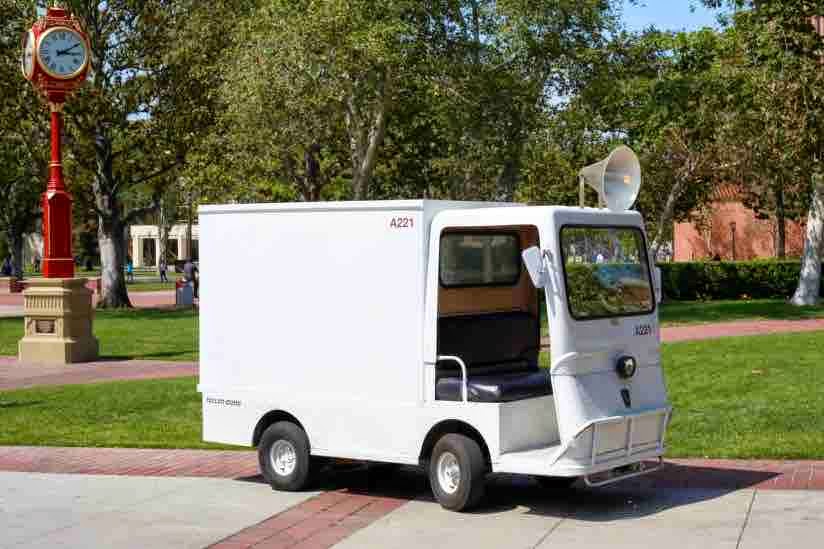
How could any project which promotes dissonance and asymmetry not be a huge success?  Here's the USC picture of one of the trucks.


Here's my picture of the same truck, A221.


Notice the added signage:

THE SCHOENBERG SOUNDWAYS
TRUCK NO.3: Erwartung Op.17, 1909-1924
Presented by USC Visions and Voices: The Arts and Humanities Initiative.  
Organized by David Schafer (Roski School of Art and Design)
For more information, please visit the Visions and Voices website  
Visionsandvoices@usc.edu or 213-740-0483
Live event and recital at Ramo Recital Hall, March 7th, 7pm.
USCExpressCatering expresscatering.usc.edu (213) 740-6801

Don't laugh.  A scheme like this just might work.

No. Go ahead, laugh. E. Randol Schoenberg, the composer's own grandson, wrote on his Facebook page "This may be the funniest thing I have ever seen . . .". (Has he never watched a Mel Brooks movie?)

When ice cream trucks give you stuff that's good for you, important stuff like German expressionism, instead of fun fattening stuff, like say actual ice cream, they aren't as welcome.  This Far Side cartoon, posted on Facebook by Joshua Creek, drives the point home.


My friend composer Carlos Rodriguez even invented a word to describe the Schoenberg Soundways event: AUTOnality.   I think that's funny.  Would Mel Brooks get the joke?

Christian Hertzog shared a video of an early Steve Martin television special. Here Steve's working with a string quartet which performs music by Bartok, Schoenberg's contemporary.  Since our friends the paying concert audience actually like Bartok's music, Bartok is well on his way to being regarded as a truly great composer.

Steve Martin does his best to make this bit funny.  Mel Brooks would have been funnier.


I decided to visit the campus during this autonal event. I wanted to witness it for myself.  So, last Thursday, before meeting Leslie who works nearby, I spent an hour and a half searching the USC campus for Schoenberg in the wild.

The USC campus is a big busy place filled with students coming and going or just hanging out. The most common modes of transportation seem to be skateboards and bicycles. There were also many little white electric vehicles of various designs.

It took a while to locate any of the five special Schoenberg trucks. I found only two. They were number two labeled "Gurrelieder" and number three labeled "Erwartung".  These two trucks passed me four times. I recorded each drive-by on video. Then I edited these videos into a single 2-minute YouTube upload.

Please note that I have not altered the audio levels. The moment when the Erwartung truck driver honks at a bicyclist is the loudest sound I heard these trucks make.  Sometimes the sound seemed to be turned off completely.  I was only a few feet away.  Notice how interested in the music the students seem.


You probably want to ask "David, why do even you care about this?" Good question. On one level it's just a silly art project. Or maybe it's a badly executed on-campus concert marketing stunt.  It's certainly not doing Schoenberg's legacy any favors.

I do find the idea of playing music on mobil vehicles very interesting.  Not important, just interesting.  Doing this on a college campus has a lot of potential, in my opinion.

Done well, a project like this would blend musical sounds with environmental sounds.  Music from multiple trucks would also combine in unexpected ways. I like that sort of thing; I'm the kind of person who sometimes listens to multiple pieces of music simultaneously.

A proper presentation on a large college campus would require many more vehicles.  You could even mount small loudspeakers on bikes and skateboards and synchronize them all with some sort of wi-fi.  You would turn up the volume if you really wanted to attract any attention.

It might be better to have music specially composed for this situation.  I wonder if there is a student composer at USC right now who would risk jeopardizing their future career by composing for ice cream trucks?

If you insist on using already existing music Schoenberg is clearly not your man.  Still, an important big-name composer would give a project like this much more visibility.

Someone suggested Karlheinz Stockhausen because he's the guy who wrote a string quartet where each player travels in their own helicopter.   I suspect that if Karlheinz were a USC professor he'd jump at the chance to write a new piece for five ice cream trucks.  Or 500.

Karlheinz Stockhausen is definitely an important composer even if he isn't around any more to write new pieces.  Maybe a professor could present a lecture explaining why his music is also interesting.


Here's an interesting explanatory interpretation of a piece by Arnold Schoenberg:


Here's a picture of me, years ago, playing the clarinet in an actual ice cream truck.  This was taken by a photographer named Mike Bloom.  Now it dawns on me!  I must have written this entire article because I needed an excuse to publish this picture.


Check out the vast collection of Schoenberg self-portraits at the Arnold Schönberg Center.

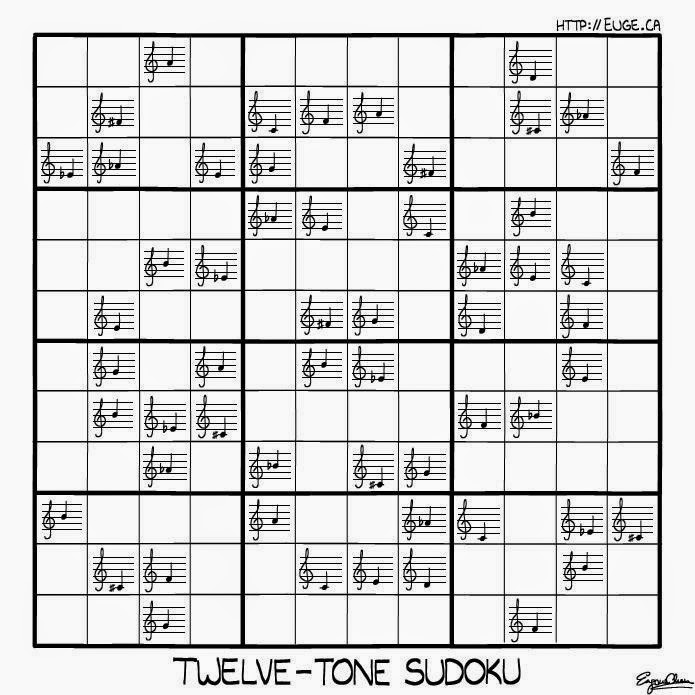
The twelve-tone sudoku puzzle apparently originated here.

A Mixed Meters post about Schoenberg's life in Southern California: Schoenberg in Hell

Two other MM posts about Schoenberg suffer from missing Internet links.  They are not important, just somewhat interesting if you use your imagination: Schoenberg and Shostakovich for Marching Band and Mozart's Penis vs. Schoenberg's Penis

Mixed Meters posts about ice cream:  Ice Cream Wishes (which is mostly about Yoko Ono), Che's Brand (only because it has a picture of an ice cream bar called Cherry Guevara), or Four 30 Second Spots in the form of a Horoscope (a very early post where each short piece of music is illustrated with a picture of disgusting ice cream).

An Antenna Repairmen Performance - a recent post involving the Roski School at USC