Showing posts with label classical music. Show all posts

Friday, October 23, 2015

Summer 2015 from The Seasons

Summer 2015 is the fifteenth season of my endless musical series unsurprisingly named The Seasons.  Lately I've begun posting multiple versions of each season; Summer 2015 will have four separate versions.  This post marks the debut of the long version - the one where each of the 90 or so daily musical segments is followed by a long silence.  Listen to it here.

The title Summer 2015 reminded me of Samuel Barber's famous work for voice and orchestra entitled Knoxville: Summer of 1915.  I can think of two similarities between his work and mine: the word 'summer' and the number '15'.  Beyond those two things Barber's impressionistic tone painting of a six-year old boy's memories of idyllic life in Tennessee just prior to the death of his father could not possibly be more different than my music presented here.  Summer 2015 bears no relationship, connection or comparison to Knoxville: Summer of 1915 - in this universe or in any other.

Summer 2015 is more than one and a quarter hours long and it contains 57 minutes of complete silence.  If you're not a regular MM reader you may well wonder why anyone writes music which is 75% complete silence.  Actually, some Seasons have an even higher percentage of silence.  Answer: I hope that listeners will combine these long Seasons with other music at exactly the same time.  This requires someone to choose which Seasons to play simultaneously with which other music.  Feel free to choose from any music whatsoever.  There's an awful lot of music out there, too much; the possibilities are literally infinite.

(If you want to listen to several Seasons together - something I often do myself - go to The Seasons page and click on several [listen] links in the first section The Seasons.  You'll need a pretty good Internet connection.  Need a suggestion of what to click on?  You might try all the Spring seasons at once or all the 2013 seasons.  Four is a good number.)

Once you make the necessary creative decisions just carry on with life - let the sounds be background.  The result will inevitably be filled with many unintelligible moments, occasional bursts of intense chaos and the periodic bright flare of pure serendipity.  It does not make sense to evaluate the result the same way you would a conventional piece of music.  This is a random process, like life.

You could listen to Summer 2015 and Knoxville: Summer of 1915 at the same time.  I tried this.  At first I put the Barber on repeat play and Mr. Barber dominated the mix.  I was happier with the results when I listened to all four Summers (two of them are based on classical music) and then added Knoxville: Summer of 1915 just one time.    I'm sure Samuel Barber's publishers will spin in their graves when they read about this.

Click here to hear Summer 2015 from The Seasons  - by David Ocker, © 2015 by David Ocker, 4494 seconds


Friday, September 25, 2015

Timeless Music

Dear Readers - this post, Timeless Music, was written sometime in the autumn of 2009.  I suppose that I was not quite finished and intended to make changes or add further thoughts.  In the six intervening years I've apparently forgotten what those changes or additional ideas were going to be.

What follows is, word for word, exactly the way I abandoned this article back then - although I've updated links and added the pictures.  Only the last picture is relevant to the subject matter while the others are from a series called Half Grassed.  I'm sad that the argumentative and occasionally bigoted comments on the LA Times story Loving Wagner Anyway don't seem to be available anymore.  At the end there's something I labeled "Footnote".  I'm guessing that was a sidetrack I'd cut out of the essay but hadn't yet gathered enough courage to delete.

In honor of Mixed Meters' Tenth Anniversary which was on September 16, I'm rescuing this and a couple other pieces from obscurity.  While I doubt they will get much attention on the Internet, they certainly will get more than they do in my draft folder.

Six years is the briefest of instants in the realm of the timeless.  This subject matter still seems relevant to me at the moment thanks to the Los Angeles Philharmonic's current Immortal Beethoven promotion.  Go ahead, call him immortal, I don't much care anymore.  Back in 2009 I cared a lot; that was a Wagner thing.

As always, many thanks for reading Mixed Meters - or at least for skimming through quickly.

//David


How long is "timeless"?

Timeless could mean existing, without change, from the very creation of the universe (whenever that was) until the very end (if it happens). Actually, something that lasts longer than the universe would be truly timeless. Not a useful definition.

How about a geologic timescale? Could Mount Everest be considered timeless? Or, closer to home, the San Andreas Fault? Both features might last only tens of millions of years.

Billions of Years or Millions of Years? I can't grasp much difference. Both are incomprehensible. Understanding a millennium - a mere thousand years - is daunting by itself. And I've lived in two of them.


I'm bothering you with this silly bullshit because the phrase "timeless music" pushes my buttons. I've run across it several times lately in various forms. Anyone can claim that certain music is timeless because choosing which music is timeless is a personal decision. Timeless implies that anyone, in any decade, any century, any millennium, will find the music meaningful. A genuinely timeless work ought to remain so regardless of changes in culture, economics or politics. It's a tall order.

Mostly I hear the phrase used about so-called Classical Music, a term less than 2 centuries old. (Centuries!) Some people claim their favorite, most comfortable, friendly and meaningful Classical music is timeless. They assume others will agree thoughtlessly.

People with similar musical tastes, possibly the result of similar musical education, tend to gather together and agree about which music they think is timeless. That's great. But when they start suggesting that their music will bring personal, civic or cultural improvement to outsiders, I become upset. Such proselytizing does nothing good for the world of classical music.


I ran across a button-pushing use of the phrase "timeless music" recently in a Los Angeles Times letter to the editor. Someone named Mark A. Overturf wrote a response to this editorial about elitism, ethnicity, race and Gustavo Dudamel:

Or why not stop reading race into something as beautiful as classical music? Try going to a concert some night and listening to a world-class orchestra in a world-class venue performing timeless music -- hence the name "classical."
If the author is suggesting that it doesn't matter whether or not Beethoven was black, I'm in full agreement.

I suspect Mr. Overturf is really saying that matters of social class distinction will be more easily overcome if people would only listen "to a world-class orchestra in a world-class venue". His utopian ecstasy is available to anyone if they only have ears to hear. Certainly has a religious ring to it. Religion is an important element of timelessness.


Here's something I wrote in an online discussion about another L.A. Times article. I was responding to a writer named MarK who called Wagner's operas "timeless and universal". (I can't deal with "universal" right now. Please wait for the next rant.) I wrote:

Timeless? How can an opera that was barely begun 150 years ago be considered timeless today? Religions which are millennia old with billions of adherents might, just barely, be considered timeless. But the Ring could completely disappear from the culture in another century.
Needless to say, MarK was not swayed by my argument. (If you read "Loving Wagner Anyway" by Mark Swed, be sure to read all the comments. One rarely encounters such blatant old-fashioned, dare I say timeless, anti-semitism.)

Anyway, in that quote I was trying to compare the relative time spans of a much beloved religion (such as Christianity, now two millennia old and counting) to that of a much beloved classical composer (Richard Wagner - less than two centuries and counting).

Does 2000 years qualify Christianity as "timeless"? It might. Will Christianity still exist in any recognizable form in another 2000? Will any of the basic principles remain unchanged? Possible. But without an argument based on faith no one can be certain.

Similarly, can anyone say that Wagner (or Beethoven or Bach) will still be revered or performed or even remembered after 20 centuries? To suggest such a thing requires a good deal of that pure simple faith.

Personally, I wonder if the talents needed to perform 21st century classical music will even be taught in the year 4000? I suppose that aspiring musicians then, just as now, will want to study what they need in order to get work. Will they have violins to play? Will people listen to mp3 files? Will the army of musicologists have grown enough to determine definitively if Wagner was an anti-semite?


Back here in the present, musical timelessness appears - hardly noticed - in curious corners, often part of a marketing campaign. I guess timelessness sells music with a familiar notion: "this music is good for you."

For example, I received a print brochure for the upcoming season of Los Angeles' own Monday Evening Concerts. It includes this anonymous audience member's quote:

It was really something that could not be described. And for me it verged on a religious experience.
There's no indication what indescribed music is being discussed. But apparently suggesting that an epiphany might be had by buying tickets is good marketing.

Recently I noticed the concept of timeless music at Starbucks. Starbucks once fancied itself a music store but today hawks only a few CDs. Right now they're selling albums by those immortal artists Barbra Streisand and Michael Buble displayed under a placard reading:

Music made to stand the test of time.
I wonder if "standing the test of time" is the first step canonizing "timeless music"? Will MarK or Mr. Overturf agree that Michael Buble might someday become "timeless". (I'm pretty sure they won't.)


I wish the idea of "timeless music" didn't bother me. It does because I am someone who searches for novelty in music. Novelty is getting harder and harder to find. These days I rarely hear anything new that does not remind me of something I've heard before.

There are a few pieces I enjoy hearing repeatedly. I would never suggest that others will react the same way. Certainly my all-too-unique listening habits plus my unusual educational and career background color my opinions about what music is good and which isn't.

I also wish that promoting music with religious overtones didn't bother me. I believe everyone should belive what they want - and everyone else should leave them alone.

Sometimes it is suggested that certain composers are inspired by God. In reality, composers are insecure, neurotic people, working under a deadline, trying to guarantee that each new piece sucks less than the previous one. God has nothing to do with it.

As my friend Armen said once: "I don't believe in Beethoven because there is a God. I believe in God because there is Beethoven." That's his choice, of course - and, because he has flipped the normal cause and effect, I find it a beautiful sentiment. Would that more of the classical music audience thought along these lines.

Personally I believe that the meaning of classical music comes not from the composer but, instead, from each individual listener. Through a process of consensus, so-called timeless music has achieved a kind of default meaning over the years. Eventually people begin to mistake the origins of that default consensus. They imagine it comes from out there, somewhere. In reality its real source is deep within each of them.

I believe that the consensus about classical music needs to be challenged. I hope what we have now is not permanent. I hope new meanings will be found for old pieces. I hope new pieces will find new meanings as well. I hope more of the audience will think independently. I hope fewer people will suggest that their favorite music is timeless. I hope they spend their time enjoying it and being moved by it right now.

I hope for utopia.


[FOOTNOTE?]

Only old pieces, the ones heard over and over again, become timeless. New pieces are never timeless. ("Never timeless" is quite a concept.) New pieces must be vetted over time to achieve their certification.

Long unchanging drone pieces might seem timeless - but the mere act of lasting a long time is not what is being discussed here. In today's musical climate a piece might last six hundred or a thousand years without the slightest claim to being timeless. There's even a Timeless Music Festival.

Often "timeless" music is actually "timely", meaning it is still relevant in society. Beethoven's Ninth is timely because there are those who need to hear the message of universal brotherhood. Suppose humans actually survive until an age of universal brotherhood. Will anyone have reason to bother with the Ninth again?

Of course, the meaning people find in the Ninth is largely based on its text. Maybe it's Schiller who is actually timeless, not Beethoven.

The one creative artist closest to achieving timeless status is Shakespeare. His plays have the advantage over abstract music because words have more specific meanings than notes. To my knowledge, no one ever suggests that watching Shakespeare can solve the world's ills. I suppose there are people who attend theater with the same fervor of the Bayreuth audience. People seem to need to believe.

Friday, March 13, 2015

Ice Cream Trucks Play Schoenberg at USC

Poor Arnold Schoenberg. In spite of being a pivotal twentieth century composer his music just doesn't get performed that much.


His early music represented the glorious excesses of late nineteenth century über-romantisch extremes. His later twelve-tone theories and his music fueled the imaginations of the post-war avant-garde. Some people, including Arnold himself, predicted that he would become one of history's great composers.

Ticket-buying concert audiences, many of whom prefer their limited repertoire repeated endlessly, have never found Schoenberg's music that interesting.   They, for better or worse, are the ultimate judges of who becomes a great composer. Perhaps audiences don't have the necessary familiarity with the history or theory of music to comprehend the importance of Schoenberg's music.  And there's no question that Schoenberg is definitely important.  The problem is that a lot of people don't find his music that interesting.


A good place to learn why important things are interesting is in academia.  That's where professors explain Schoenberg in the context of music history.  They can teach you why he believed that his radical twelve-tone composition theory was both necessary and inevitable. And they teach how later composers, ones who don't get performed much these days either, mutated those ideas into even less comprehensible theories and structures.

Once you know all that, maybe you'll find Schoenberg's music more interesting.

But first listen to this fun mash-up for two pianos by Kyo Yoshida.  Music by Arnold Schoenberg and by George Gershwin combined together into one piece.  The two composers were friends here in Southern California.


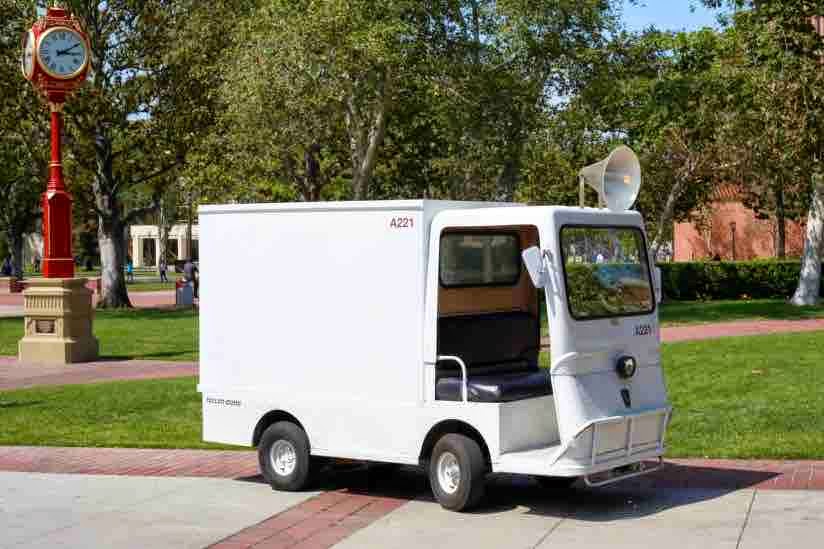
Last week, in an effort to drive up interest in Schoenberg's works, the University of Southern California, home of the most important music school on the Pacific Rim, decided to broadcast his music in a novel manner, by playing bits of it on loud speakers mounted on small electric trucks which roam the bucolic campus.

The intent, I suppose, was to attract the attention of some eager young college students. Maybe hearing a bit of Schoenberg would make them curious enough to attend a concert/lecture.  There they might learn why Schoenberg is both important and interesting.

This was the idea of USC art professor David Schafer. Read the press release here.  Here's a quote:
Avant-garde music will fill the air of the University Park Campus next week, thanks to a Visions and Voices project that will mount loudspeakers on five USC Hospitality trucks making their regular deliveries around campus. The trucks will be playing works from the late Austrian composer Arnold Schoenberg, who revolutionized music with his 12-tone system that produced dissonant and asymmetric compositions.
How could any project which promotes dissonance and asymmetry not be a huge success?  Here's the USC picture of one of the trucks.


Here's my picture of the same truck, A221.


Notice the added signage:

THE SCHOENBERG SOUNDWAYS
TRUCK NO.3: Erwartung Op.17, 1909-1924
Presented by USC Visions and Voices: The Arts and Humanities Initiative.  
Organized by David Schafer (Roski School of Art and Design)
For more information, please visit the Visions and Voices website  
Visionsandvoices@usc.edu or 213-740-0483
Live event and recital at Ramo Recital Hall, March 7th, 7pm.
USCExpressCatering expresscatering.usc.edu (213) 740-6801

Don't laugh.  A scheme like this just might work.

No. Go ahead, laugh. E. Randol Schoenberg, the composer's own grandson, wrote on his Facebook page "This may be the funniest thing I have ever seen . . .". (Has he never watched a Mel Brooks movie?)

When ice cream trucks give you stuff that's good for you, important stuff like German expressionism, instead of fun fattening stuff, like say actual ice cream, they aren't as welcome.  This Far Side cartoon, posted on Facebook by Joshua Creek, drives the point home.


My friend composer Carlos Rodriguez even invented a word to describe the Schoenberg Soundways event: AUTOnality.   I think that's funny.  Would Mel Brooks get the joke?

Christian Hertzog shared a video of an early Steve Martin television special. Here Steve's working with a string quartet which performs music by Bartok, Schoenberg's contemporary.  Since our friends the paying concert audience actually like Bartok's music, Bartok is well on his way to being regarded as a truly great composer.

Steve Martin does his best to make this bit funny.  Mel Brooks would have been funnier.


I decided to visit the campus during this autonal event. I wanted to witness it for myself.  So, last Thursday, before meeting Leslie who works nearby, I spent an hour and a half searching the USC campus for Schoenberg in the wild.

The USC campus is a big busy place filled with students coming and going or just hanging out. The most common modes of transportation seem to be skateboards and bicycles. There were also many little white electric vehicles of various designs.

It took a while to locate any of the five special Schoenberg trucks. I found only two. They were number two labeled "Gurrelieder" and number three labeled "Erwartung".  These two trucks passed me four times. I recorded each drive-by on video. Then I edited these videos into a single 2-minute YouTube upload.

Please note that I have not altered the audio levels. The moment when the Erwartung truck driver honks at a bicyclist is the loudest sound I heard these trucks make.  Sometimes the sound seemed to be turned off completely.  I was only a few feet away.  Notice how interested in the music the students seem.


You probably want to ask "David, why do even you care about this?" Good question. On one level it's just a silly art project. Or maybe it's a badly executed on-campus concert marketing stunt.  It's certainly not doing Schoenberg's legacy any favors.

I do find the idea of playing music on mobil vehicles very interesting.  Not important, just interesting.  Doing this on a college campus has a lot of potential, in my opinion.

Done well, a project like this would blend musical sounds with environmental sounds.  Music from multiple trucks would also combine in unexpected ways. I like that sort of thing; I'm the kind of person who sometimes listens to multiple pieces of music simultaneously.

A proper presentation on a large college campus would require many more vehicles.  You could even mount small loudspeakers on bikes and skateboards and synchronize them all with some sort of wi-fi.  You would turn up the volume if you really wanted to attract any attention.

It might be better to have music specially composed for this situation.  I wonder if there is a student composer at USC right now who would risk jeopardizing their future career by composing for ice cream trucks?

If you insist on using already existing music Schoenberg is clearly not your man.  Still, an important big-name composer would give a project like this much more visibility.

Someone suggested Karlheinz Stockhausen because he's the guy who wrote a string quartet where each player travels in their own helicopter.   I suspect that if Karlheinz were a USC professor he'd jump at the chance to write a new piece for five ice cream trucks.  Or 500.

Karlheinz Stockhausen is definitely an important composer even if he isn't around any more to write new pieces.  Maybe a professor could present a lecture explaining why his music is also interesting.


Here's an interesting explanatory interpretation of a piece by Arnold Schoenberg:


Here's a picture of me, years ago, playing the clarinet in an actual ice cream truck.  This was taken by a photographer named Mike Bloom.  Now it dawns on me!  I must have written this entire article because I needed an excuse to publish this picture.


Check out the vast collection of Schoenberg self-portraits at the Arnold Schönberg Center.

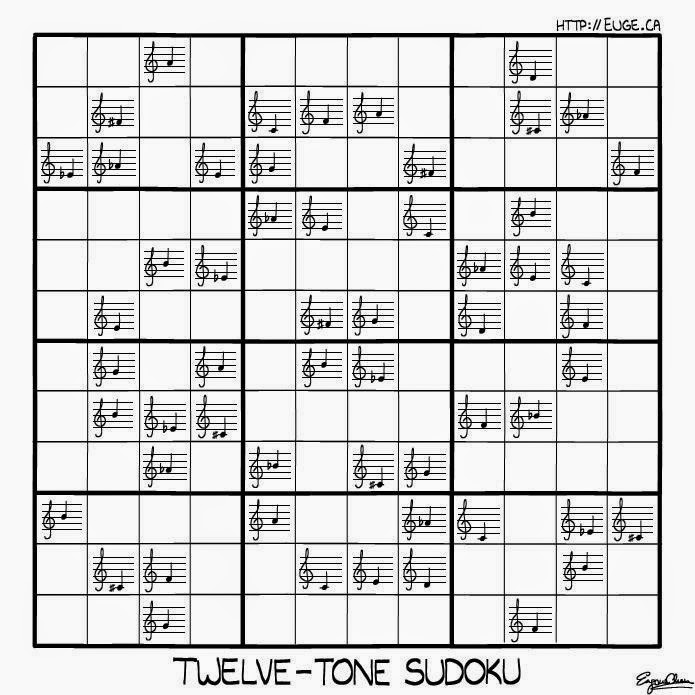
The twelve-tone sudoku puzzle apparently originated here.

A Mixed Meters post about Schoenberg's life in Southern California: Schoenberg in Hell

Two other MM posts about Schoenberg suffer from missing Internet links.  They are not important, just somewhat interesting if you use your imagination: Schoenberg and Shostakovich for Marching Band and Mozart's Penis vs. Schoenberg's Penis

Mixed Meters posts about ice cream:  Ice Cream Wishes (which is mostly about Yoko Ono), Che's Brand (only because it has a picture of an ice cream bar called Cherry Guevara), or Four 30 Second Spots in the form of a Horoscope (a very early post where each short piece of music is illustrated with a picture of disgusting ice cream).

An Antenna Repairmen Performance - a recent post involving the Roski School at USC

Thursday, October 30, 2014

The Two F. Zappas

Zappa means hoe in Italian.  Jacopo told me that.  Jacopo is Jacopo Franzoni, a fan of all composers named F. Zappa - of which there have been two.  One was Frank Zappa, famous composer and rock star guitarist of the 20th century.  The other was Francesco Zappa, unknown composer and cellist to royalty of the 18th century.

Jacopo recently organized a conference in Milan Italy devoted to both F. Zappas.  Before the conference he interviewed me about the Two Zappas via the miracle of Skype.  Then he edited video from several hours of our conversation down to a concise 8 minute long video.  This was shown at the conference.

If any one thing unites the people of Italy it is that they speak Italian.  Sadly, I know only a few words in Italian and these are all nouns which fall into one of two categories: music (e.g. "fermata") or food (e.g. "martini").  Please don't remind me that these have long since become English words.

To make it easier for those attending the conference to understand my palaver, Jacopo added Italian subtitles to the video.  When he told me that he intended to do this I expressed some curiosity about how I might look that way.  Jacopo replied that I'm much more handsome with Italian subtitles.  I'll let you be the judge.


Here's another of Jacopo's videos in which I appear briefly.  It's the trailer for the conference.  Jacopo called it the "appetizer".


You might notice that Jacopo Franzoni shares billing with Vanni Moretto.  Vanni is a conductor who specializes in Baroque and Classical repertoire.  His ensemble is called Atalanta Fugiens and guess whose music they've recorded.  If you answered F. Zappa you'd be correct.

First, here's some 18th century F. Zappa, a movement from a symphony:


I'm very impressed by the quality of their performance.  I just discovered that Atalanta Fugiens has recorded all six Zappa Symphonies on an album from Deutsche Harmonia Mundi.  I look forward to hearing all of them.


Now some 20th century F. Zappa played by the same talented ensemble.


Now back to the 18th century guy.  This is Francesco Zappa's trio Opus One, Number One:


If you dare, compare that to the same music performed 30 years ago by the Barking Pumpkin Digital Gratification Consort, Frank Zappa conductor.  "Synclavier Document Encryption" for this was provided by David Ocker, Assistant Director of the consort, who all by himself was actually the entirety of the membership.


I know you can't resist asking "Who was Francesco Zappa"?
I've written about Francesco Zappa before, here.
Francesco has his own website, here.
Fascinating new information about Francesco's life and death, here.

Friday, December 27, 2013

The William Bell Overture (Jingle Tells)

Traditions are a bitch.

I've created some traditions while writing this blog and these have become my own little bitches.  I'm completely responsible for them.  No one else will celebrate them for me.  They're my personal sacred rituals.  Obsessive compulsions.  They demand fulfillment.  They will be served.  If I miss a year, these observances will haunt me for ignoring them.  I just know it.

One such Mixed Meters tradition is the yearly Jingle Bells piece.  These have taken various forms since 2006.  I take pride in making each new one as different and unexpected as possible.  As this autumn wore on, closer and closer to the winter solstice, I searched for a musical idea which would be both new, to me at least, and also include the trope known as Jingle Bells.

At one point I was driving while thinking on this issue.  The announcer of our local classical radio station introduced the overture to Gioachino Rossini's final opera William Tell.

If you had been with me in the car you might have seen the proverbial compact florescent bulb light up over my head.  I had had an idea: I could combine the music of the William Tell Overture with the melody of Jingle Bells.  I knew instantly that this idea would work.


Ideas are a bitch.

At least the good ideas are.  I suspect that is how you know that an idea is a good one, by how it behaves.  Bitchy ideas, like bitchy traditions, will grab your brain with their soft little fingers and not let go.  Later, if your final product is not good, blame will not rest with the idea.  The culprit will obviously have been an insufficiently talented composer.  Good ideas, by definition, are blameless.

Here is a video about an artist who has been very successful in the art of having ideas (John Baldessari) narrated by a musician with the most gravel-toned voice (Tom Waits).  Why am I including it here?  Because much of the soundtrack is from the William Tell Overture.  Duh.  (Fun video.)


You might already know the William Tell Overture.  It is the epitome of a music appreciation course curriculum, a classical warhorse, a trite chestnut, a hackneyed tone painting that needs no description because it describes itself.  I bet it would be hard to find someone so musically illiterate, so tone deaf that they can't hear the musical depictions of a storm, birds singing or horses galloping.

The last section - the horse business - now apparently known to online music databases as "the finale from the William Tell Overture" - was for decades the theme of a radio and television show called The Lone Ranger.  That's how a bit of the opera William Tell, part and parcel of the European white-guy classical music canon, became an inextricable element of American culture.

The overwhelming majority of Americans have no interest in Italian operas written in 1829 about sharpshooter Swiss patriots.  Heck, most Americans have no interest in the first half of the overture, the part which doesn't sound like a horse.  Most Americans are not fans of classical music.

Classical audiences do seem to enjoy having a laugh at the expense of their favorite music.  People like Gerard Hoffnung, Victor Borge, Peter Schickele and Igudesman and Joo have given them the chance.  It's gotten to the point where making fun of classical music has its own long and hallowed tradition.

Another famous musical comedian, Spike Jones, didn't play to a classical audience the way the others did.  He played to a pop audience who actually were familiar with some of the classics.  I guess times have changed.  Here's his classic William Tell parody:


Apparently the tradition lives on elsewhere.  I discovered this on YouTube:


Here's a fun anecdote, found in the L.A. Times, about Arnold Schoenberg and the Lone Ranger:

Nonetheless, Schoenberg adapted to California life with surprising ease: He listened to UCLA football on the radio, wore wacky polka-dot ties and once made fun of a student's composition by galloping around the room and shouting "Hi-yo, Silver!"

And here's an article about a major orchestra performing live during a horse race.  Can you guess which piece they programmed?


Meanwhile of course there's also Jingle Bells.  It is only a few decades younger than the William Tell Overture - but still pretty old and even more a part of our culture.

I was sitting in our backyard a few weeks ago reading.  We live on a corner so that there's a sidewalk on the other side of the hedge.  People walk up and down but can't see into our yard.  As I was reading I could hear a young girl's voice.  She was singing Jingle Bells to herself as she walked down the street.  She seemed very happy.

Her happiness now is the formative stage of her Christmas nostalgia later in life.  Nostalgia is powerful magic and seems like an essential part of both Christmas music and Classical music.  Here's the definition of nostalgia:

a sentimental longing or wistful affection for the past, typically for a period or place with happy personal associations

Nostalgia is what advertisers evoke when they use Christmas music to sell us stuff.  Someday that girl will wonder why she can be manipulated into spending money so easily when she hears Jingle Bells and other Christmas tunes.

Here is Jingle Bells being used to sell sexy underwear for men.  I'm guessing that this ad is designed to convince mostly women, not men, to buy these as gifts.


Here's a chart (from here) which encapsulates the interaction of the Christmas music industry with Baby Boomers' nostalgia for their childhoods.


The Baby Boomer part of the hypothesis is probably wrong simply because everyone, not just Boomers, has nostalgia.  These songs have been part of every subsequent generation's childhood.  Still, for all the harm we Boomers have actually done to our society over the last few decades, we might as well take responsibility for screwing up Christmas music too.

One thing to remember about these twenty songs is that they are all under copyright.  Someone - probably big corporations - owns them.  The corporations receive money each time they are played. It would not be surprising to learn that the same corporations own many of the radio stations surveyed for the data behind this chart.

The William Tell Overture and Jingle Bells are still in the public domain.  I expect Disney Corporation is probably busy trying to bribe congress into changing that.  Until they succeed, however, I am free to combine those tunes in any manner I want and even claim my own copyright over the result.

What I have actually done is to make an "arrangement".  My William Bell Overture (or you can call it Jingle Tells if that pleases you) is not really an original David Ocker composition.  Younger generations might prefer to call it some sort of old-fashioned classical music mash-up.  Science Fiction geeks might enjoy the image of creating a hideous musical mutant by splicing the melodic genes of Jingle Bells into the harmonic and formal structures of William Tell.

Whatever name you give the final piece, my original idea did in fact turn out to be a bitch.  And I have managed to celebrate another year of my personal, bitchy holiday tradition.  Also, please forgive the cheap synthetic orchestra sound.

Click here to hear The William Bell Overture (Jingle Tells) - © 2013 by David Ocker 390 seconds

I do sort of wish that I had waited a few more days before starting on this project.  I might have come up with a better idea.


P.S. There is no truth to the rumor that this piece was once entitled "I Saw the Lone Ranger Kissing Santa Claus".

Wednesday, November 30, 2011

Occupy New Music

As I write this (just before 3 a.m.) about a thousand LAPD officers are removing Occupy Los Angeles from their camp surrounding City Hall.  We knew the eviction would happen eventually.  Occupy LA are people protesting that 1% of us have too much wealth, about 33% of it.  The 1% want Los Angeles to open for business normally in the morning.  I'm sure they will get what they want.

Meanwhile, the Occupy Meme has finally reached a point of absurdity with Occupy New Music.  Apparently it comes in the form of a graphic from Eric Guinivan on Facebook.  It was sent to me by one of Mixed Meters' three readers, Scott F.   The graphic tells us
The top 1% of composers control 99% of orchestral concert programs.
Here's the image:


The composers shown are Haydn, Mozart, Beethoven, Mendelsshon, Brahms, Tchaikovsky, Mahler, Ravel, Debussy, Bartok, Stravinsky and Shostakovich.

It's a clever idea.  There's no question that the symphonic repertoire favors a chosen few.  A few composers are performed repeatedly and outsiders have a hard time getting heard in concert halls.  Still, you've got to wonder about this 99% statistic.  Can the real numbers truly be that lopsided? I decided to take an educated guess.

A website called Instant Encore posted a list of the top 150 composers, by frequency of performance, during 2010.  They say the data represents over 42,000 concerts worldwide, including opera.  This is a bit different in scope than the assertion of the Occupy New Music graphic which seems to exclude opera.  What the heck - let's run with it.

All 150 composers get a total of 44,279 performances. Number one is Mozart, at over 3000, down to Luciano Berio in the coveted 150th spot with 43 performances.  One percent of 150 composers is one and a half composers:  Mozart (3035) plus half of Beethoven (2859/2 = 1430) is 4465 performances.  That's a smidgen more than 10% - nowhere near 99%.

Let's extrapolate.  The top 10 get 16,899 performances between them.  That leaves the other 140 with 27,380 - for an average of 195 performances per composer.  To compare the top 10 composers on Instant Encore's list, I'd need data for 850 more composers.  That's because 10 is 1% of 1000.

I'm going to take a guess at the average number of performances for composers 151 through 1000.  I guess 20 (about 1/10 of 195):  850 x 20 = 17,000.    All 1000 composers thereby get 44,279 + 17,000 = 61,279 performances.  This means that the top 1% of 1000 composers get 16,899/61,279 of the total.  That's 27.6% - a far cry from 99%.

Further extrapolation: suppose the composers ranked from 1001 through 100,000 get an average of 2 performances each (one tenth of 20).  That's 99,000 x 2 = 198,000 performances.  Now the top 100,000 composers get a total of 259,279 performances.  In this scenario the top 1% of them (1000 composers in this scenario) usurp only 23.6% of all performances.

If composers 1001 through 100,000 get an average of one performance each, the top 1% get 38.2%.
If composers 1001 through 100,000 get an average of one tenth of a performance - meaning that fewer than 1 in 10 gets performed at all (very unlikely) - the percentage finally approaches the realms of Occupy New Music: 86.1%.

While the notion that 1% of composers get 99% of the performances is extravagantly high in my opinion, in reality the distribution of composers is extremely lopsided, whatever the true number.  The classical audience simply wants to hear their favorites over and over.  That's what they will spend money on.  They are really not interested in new musical ideas - they want proven masterpieces.  (This is where, in an infinitely long blog post, I would suggest that symphonies are really more like museums - devoted to preserving historical artifacts.)

If you love symphonic music enough to write your own music in that tradition, you need to accept the unfairness of reality.  There's lots of other music worlds you could be living in rather than beating your head against an art form which pretty much defines the notion of "resistant to change."  But the 150 composers did include, by my count, 18 names of living people - so you've still got a chance.  Only 2 women.  Just one black person (well, two if you think Beethoven was black).

You've got a small chance.  Very small - but it's a better chance than you have of winning a lottery jackpot. 


Instant Encore also listed the most frequently performed 225 classical works of 2010.  The list includes just one piece by a living composer.  You'll never guess, so I'll tell you: it's Jonathan Brielle's Nightmare Alley.  Who?


Mixed Meters has a dour take on classical music.  Deal with it in these posts:


The Lifespan of Classical Music  "I think classical music is quite dead. It's easy to overlook this fact because many people still enjoy listening to it."

If Music Be The Food of Love "Hip Hop, as the magazine cover says, is not dead. However Hip Hop has recently discovered its own mortality."

A New Rhapsody in Blue  "It occurred to me that if many (or even a few) performances of classical music had this level of creativity in them - of even a small fraction of the creativity in this performance - I would not think of it as such a dead art form."

Everybody Loves Beethoven (Probably)  "it is probable that 98% of all Americans these days don't know any contemporary composers at all, and if they did - unlike in Mencken's hypothesis - their reaction to finding out about them would be the shrugging of shoulders and the changing of channels."

Classical Music Isn't Dead, It Just Needs a Rest  "I conclude that in such situations the music is not meant to offer a contemporary perspective. They have other forms of art for that. I fear this music is more like a spa treatment for ones ears."

Could Terry Riley's In C be Accepted As Classical Music?  "Yes, getting this piece into the standard repertory is a long ways off. If it happened, In C would change from a "minimalist classic" into an actual piece of classical music. That would provide strong evidence that classical music has some life left in it."

Ten Most Influential Classical Composers  "But the real burden of Mozart for modern composers is that he was so blasted young.  The cult of the young genius lives on strongly.  These days a 30-year old composer who hasn't made it yet, won't."


ADDENDUM:

Composer Philip Glass joins Occupy Lincoln Center protest (L.A. Times - Dec. 2, 2011)
Glass is likely in the nation’s highest tax bracket, but there was a time he drove a taxi cab to support his music career.   
... and soon others took the mike to call out statements like: "Tickets are for the 1%," "Revolution for the arts" and "Opera belongs to the people!"


Occupy Tags: . . . . . . . . .

Friday, September 30, 2011

The Preserving Machine by Philip K. Dick

I've been enjoying a book of early short stories by Philip K. Dick, master science fiction author. These stories, from the early fifties, are filled with mind-bending ideas and less than stellar prose.

The Preserving Machine was published in June 1953. Besides a narrator, the main character is named Doc Labyrinth. The action takes place in Los Angeles.  Dick opens with a description of suburban L.A.
I was standing by the barbecue pit, warming my hands.  It was a clear cold day.  The sunny Los Angeles sky was almost cloud-free.  Beyond Labyrinth's modest house a gently undulating expanse of green stretched off until it reached the mountains - a small forest that gave the illusion of wilderness within the very limits of the city.  "Well?" I said. "Then the Machine did work the way you expected?"
This Machine, the Preserving Machine, is pretty amazing.  It preserves sheet music in a most remarkable manner.  And not just any sheet music, but classical music in particular. 
This is how he came to think of the Preserving Machine.  One evening as he sat in his living room in his deep chair, the gramophone on low, a vision came to him.  He perceived in his mind a strange sight, the last score of a Schubert trio, the last copy, dog-eared, well-thumbed, lying on the floor of some gutted place, probably a museum.

A bomber moved overhead.  Bombs fell, bursting the museum to fragments, bringing the walls down in a roar of rubble and plaster.  In the debris the last score disappeared, lost in the rubbish, to rot and mold.

And then, in Doc Labyrinth's vision, he saw the score come burrowing out, like some buried mole.  Quick like a mole, in fact, with claws and sharp teeth and a furious energy.

If music had that faculty, the ordinary, everyday instinct of survival which every worm and mole has, how different it would be!  If music could be transformed into living creatures, animals with claws and teeth, then music might survive.  If only a Machine could be built, a Machine to process musical scores into living forms.
This being a Science Fiction story, you know that the machine gets built - and in due course music animals are created.  The above quote might lead you to expect animals based on particular works, like a Schubert trio.  Instead, Dick gives us composer animals.  For example:
After that came the schubert animal.  The schubert animal was silly, an adolescent sheep-creature that ran this way and that, foolish and wanting to play.
Once they become animals, their name is no longer capitalized.  The mozart animal is a bird, beethoven a beetle, brahms an insect, stravinsky another bird.
The wagner animal was large and splashed with deep colors.  It seemed to have quite a temper, and Doc Labyrinth was a little afraid of it, as were the bach bugs, the round ball-like creatures, a whole flock of them, some large, some small, that had been obtained for the Forty-Eight Preludes and Fugues.
Of course, all these critters escape into the nearby forest and begin to evolve and compete.  Some survive, others succumb.  The Doc feeds an evolved bach bug back into the machine, reconverting it into sheet music which he then performs at the piano.
I listened to the music.  It was hideous.  I have never heard anything like it.  It was distorted, diabolical, without sense or meaning, except, perhaps, an alien, disconcerting meaning that should never have been there.  I could believe only with the greatest effort that it had once been a Bach Fugue, part of a most orderly and respected work.
Had I been writing this story, instead of Philip K. Dick,  the reconverted music would have been very strange but not hideous.  Music as it grows and evolves should try new, unfamiliar ideas, some of which will survive, others not.  Survival of the fittest?  Eventually the musical unfamiliarity ought to fade in our ears, allowing new species to contribute to our enjoyment.  Adaptation and evolution, either of music or animals, ought to be the real reason that they flourish and reproduce.  Of course pieces of music which you never hear will not survive or procreate.

These days classical music already has a fully functional, well-oiled preserving machine - in the form of symphony orchestras and opera companies and classical radio stations only too happy to reproduce the same limited number of works over and over again for audiences eager to hear their favorites one more time.  This machine discourages adaptation but it does a good job of preserving any piece which can claw its way into the repertory.  A new work, which at first might sound hideous, diabolical or alien, will never find an audience if it has to compete against the well-entrenched, machine-preserved herds of beethoven, schubert and wagner animals roaming our cultural landscape.

Animal Tags: . . . . . . . . .

Tuesday, July 05, 2011

Selling with Vivaldi

(If you have time to watch only one of these videos, definitely watch the last one, Beer Vivaldi.)

In the museum-like world of classical music one of the most revered and oft-displayed masterworks is a set of violin concertos, The Four Seasons of Antonio Vivaldi.  These pieces easily evoke meteorological images in the minds of listeners who, after all, have come to believe that music is really just like a movie - but without anything to watch.

But these pieces are among the very few which have a life as part of contemporary pop culture.  They aren't as well known as the Ode to Joy or the Ride of the Valkyries.  One doesn't have to look too hard to hear them in unexpected places - for example, as a soundtrack to a television commercial.

This short advertisement, running currently on television, shows a fearless stunt every-man jumping out of his luxury car onto an auto carrier, in hopes of acquiring an even better luxury car. The exciting derring-do music is the end of the first movment of Vivaldi's Winter. Perfect images for baroque music, don't you think?


Lest you think Vivaldi can only be used to sell automobiles, here's an ad for Hewlett Packard computers. The music is from Vivaldi's Summer and the guy waving his hands, creating fantastical images in mid-air, is none other than Joshua Bell, a violinist most famous perhaps for his performances in the Washington Metro. If he really could make visuals like these, live on stage just by waving his hands, Bell could probably become a really big star.


Lest you think that Vivaldi can only be used to sell autos and computers, here's another ad, with the very same Joshua Bell performing the same movement from the same Vivaldi concerto. The only difference is that in this one he is selling perfume, not that you can tell until the very end.  Listen for the horrible cut in the music, just before the voice over.


Lest you think that Vivaldi's Four Seasons can only be used to sell high cost, high tech or high prestige items, here's an example of it being used for a different type of product. We see a scruffy college student amidst piles of forbidding obscure tomes, apparently translating an oriental language. In his notebook he writes "The divine truth one must find lies within." This idea provokes him first to deep thought and then to begin a quest through the stacks of the library. What he finds is ... a package of noodles. (Actually it finds him.) The remainder of the saga involves fancy kitchen prep work - the kind performed nightly by inscrutable Japanese chefs at your local Benihaha.

If you're paying attention, however, this commercial should make you want to buy an Audi. Yes, this noodling music comes from the same Vivaldi movement so perfect for jumping out of your car on a busy freeway.


These four uses of Vivaldi are all pretty standard capitalist realism - art in the service of profit. Our last example is much more interesting, vastly more creative, much more focused on Vivaldi's music - it's another performance of the same Winter movement which we've heard twice already. Alas, it is also much more forgiving of over consumption - in this case the item being promoted is beer. The image we see is a creative inebriate, an otherwise anonymous person called Pianobloke who must be a big fan of beer, creating pitches on a wide selection of beer in bottles, cans and glasses - the last of which he performs like a glass harmonica. These recorded snippets are assembled into Vivaldi using fancy video editing.

This video is chock full of visual imagery. There's no way to catch everything the first time.  Go to YouTube and watch in high definition if you can.  Notice that the first note is performed on a bottle of Duff, the beer of the Simpsons. After the music finishes each bottle of beer gets a cameo shot. Then our hero passes out. Congratulations, Pianobloke, a job well done.  If you can turn out something like that I guess you weren't really that drunk. Why would you want us to think you were?


Other Mixed Meters pieces discussing classical music in advertising:
Advertising with Disney Hall  "It would be a much better world if you were reminded of classical music each time you saw the bank's stagecoach, rather than being reminded of a bank each time you saw the concert stage."

In Which David Is Confused by The Second Coming  "Does this, I wonder, sell shoes or religion?"

Who is Weiden & Kennedy Anyway  "A dark story of crushing defeat as the home team loses by one point in the last second because an opponent is wearing better shoes. Life is like that, huh?"


Violin Concerto Tags: . . . . . . . . . . . . . . .

Wednesday, January 12, 2011

Ten Most Influential Classical Composers

A New York Times music critic is spending his time picking the "ten top Classical composers of all time."  He's seeking the "greatest" composers.  The essential criterion will be, I suppose, the opinions of classical audiences.  After all, composers become great because people keep listening to their music. 

This idea got me thinking about which classical composers have the most influence on living composers.   When living composers are lucky enough to get performed they often must share the bill with the honored dead ones.  Those dead composers bring us musical ideas from the past.  Some of those ideas, but not all, still have life to them. Presumably living composers are commenting, in some fashion, on what has come before.

I suspect there are plenty of contemporary composers like myself who were inspired to take up the craft by the musical classics.  Most likely we still feel the weight of that tradition, along with other influences, when we sit down to write.  This is true even if we are not as interested in classical music now as we once may have been. 

Please note that the reasons I'm about to give for including these particular names won't seem particularly positive.  Regular readers of Mixed Meters will not be too surprised by this.  If you happen to be a composer (and who isn't) I'm sure your opinions will differ.  If you're not a composer, this might make no sense at all.  There's a comment form where good natured responses will be published.

Here's my list.  The links all lead to earlier Mixed Meters articles.

Johann Sebastian Bach   Finding a balance between beauty and technique, between inspiration and academicism is always an issue for composers.  It's a matter of simplicity versus complexity, freedom versus control.  Bach used dry, complicated musical rules and produced perfect elegance with them.  It's an unattainable standard.  How depressing.

Wolfgang Amadeus Mozart  Yes, he wrote some of the greatest pieces ever.  He's possibly my favorite composer.  But the real burden of Mozart for modern composers is that he was so blasted young.  The cult of the young genius lives on strongly.  These days a 30-year old composer who hasn't made it yet, won't.  We may well ask whatever happened to Jay Greenberg (who isn't even 20 yet.)
x

Ludwig van Beethoven He wrote some great music.  But he did two things wrong.  First, he invented the tormented composer, the Great Artiste who pours out his stormy inner life through music.  These days that idea seems really old.   Second, he went deaf - which by rights ought to be a compositional kiss of death - but Ludwig wouldn't stop writing.  Worse yet, once deaf, he wrote an unendurably grandiose symphony with one hummable tune and a few lyrics of desperate hope.  Modern audiences still can't get enough of that one.  How's a modern composer going to compete?

Richard Wagner  Mixed Meters has been bashing Wagner for over a year now.  He deserves it for the villainous political ideas which have so easily shackled themselves to his work.  But his musical innovations, possibly the most influential ever, still cloud contemporary music.  And the vast scope of some of his works, especially the Ring, ought to provoke us into keeping our music on a more human scale.     

Pyotr Ilyich Tchaikovsky  Maybe a surprising choice.  He's never been one of my favorites, but he has symphonies, concertos and ballets that audiences can't get enough of.  It's not just about shooting off canons.  I think it's about his melodies.  Contemporary composers don't seem to write melodies.  We might have lost the ability.  More likely, however, we know that if we try to compose hummable tunes, the audience will reject them in favor of ones they already know and love.

Claude Debussy and Maurice Ravel  These two count as one.  (They both wrote the same string quartet.)  Audiences have come to love their lush sound worlds.  Some contemporary orchestra composers  have recognized that they can't go far wrong by imitating the colors and textures of Impressionism.  In other words, when a new piece restricts itself to musical techniques at least 100 years old, ones that Ravel and Debussy would have understood, the audiences will go home happy.  

Arnold Schoenberg Audiences still revile Schoenberg's music.  I don't blame them.  But as the spirtual inspiration behind the serial tradition and the technique of pre-composition and the emancipation of the dissonance and the notion of "composer as professor", he's still a potent nagging voice inside any composer's head.  Also, it never hurts to reflect on how Schoenberg's career (but not his influence) was ruined by the politics of his countrymen.

George Gershwin Along with Sondheim and Ellington, Gershwin was specifically disqualified from the New York Times ten greatest competition.  While the first two don't seem like classical composers to me, George most certainly does.  Think about the popularity of his rhapsody, his concerto and his opera in concert halls.  This popularity manifests itself in ever so many pleasantly upbeat Pops concerts.  The notion of harnessing vernacular music to make a serious piece more accessible is very alluring to any composer.

John Cage His music is a long long way from the standard repertory.  Infinitely far away.  He has absolutely no chance of getting on the New York Times list.  But a serious composer has to come to terms with Cage's ideas.  And that's what his music was about: ideas.  Ideas and not much else - in my opinion.  A decent composer's education should fry the brain with Cagian philosophy.  After that you can ignore him, but he won't really go away.

Philip Glass  He's also disqualified from the Times list because he's still alive.  But I think many other composers look at him with a combination of awe and disgust.  Awe because he's so successful - with a steady string of commissions for symphonies, operas and film scores.  Disgust because we can't find a simple compositional style of our own, the way he has, one that's both direct and elegant and will bring some of our own listeners into the concert hall so we don't have to worry so much about what the Beethoven and Tchaikovsky fans think.

Don't be fooled into the notion that the great classical composers are the only influences on us lesser lights.  There are hundreds of semi-greats who can also look over a composer's shoulder if we let them.  Composition is an old art, highly developed.  There have been countless branches and offshoots.  The heavy weight of this past can be stifling if it is taken too seriously.

And any half-way decent composer is also influenced by many other types of music besides classical.  But this article was inspired by a purely "classical music" project - a futile effort to quantitatively rank composers on what must be, in the end, purely subjective judgements.  To me it sounds like a fools errand.


ADDENDUM:

Due to multiple comments I'm adding a bonus selection, a runner up.

Igor Stravinsky  He made it clear that staying current and staying famous is the most important thing for a composer.  During his career he was three different composers,  radically changing his musical style twice, both times taking ideas from others.  It would have been a gracious gesture on his part to adopt serialism before his neighbor Schoenberg died.   But had he been a really nice guy he would have stopped composing in the 1920s and given two other composers a chance to be famous in his place.

Ten Greatest Tags: . . . . . .

Saturday, May 29, 2010

Listen to Wagner's Entire Ring Cycle in One Second

Today is the first performance of L.A. Opera's complete production of Richard Wagner's endless four-opera cycle The Ring of the Nibelung.

Yesterday L.A. Opera announced that ticket sales for the Ring cycles are not meeting expectations. Their overall budget is falling another million dollars short.  Maybe a million and a half.  Their excuses include the volcano in Iceland.  Personally I think the Gods must be angry.  (Read the financial story at the L.A. Times)

The Opera is also holding Ring Festival L.A., a favorite topic at Mixed Meters. You can read about it here and here and here and here and here.  Or not.

This post is my contribution to Ring Festival L.A.  They're not likely to be thrilled.  It is inspired by the work of one California composer who, almost 50 years ago, dealt conceptually with the problem of Wagner's Ring.  I gather that his idea was never completely realized in sound. Maybe this is the first time.


BACKGROUND

From 1962 through 1966 there was a flowering of avant garde music right here in California at a place called the San Francisco Tape Music Center.   It was a labor of love by a small group of young composers who existed in the vortex of counter-culture energy and revolution which, only a few years later, would give us Flower Power, the Summer of Love and the Grateful Dead.

One of the founders of the SFTMC was Ramon Sender.  As a student I remember reading how Sender had used a tape recorder to reduce all of Wagner's Ring to four short clicks.  I assumed he would have done this by recording at a very slow speed and playing the tape back very fast.  Unfortunately, I don't remember where I read this; it was just a short reference.  Clearly the idea stuck in my brain.  (Update: See note from Sept. 2012 below.)

Recently I discovered a fascinating book called The San Francisco Tape Music Center, 1960s Counterculture and the Avant-Garde edited by David W. Bernstein.  It includes interviews with the principals of SFTMC:  composers, performers, equipment designers, dancers and light show artists.  Here's part of the interview with Ramon Sender.  He is discussing a very early three-head Ampex tape recorder:
I discovered that there was a tension adjustment on the reels.  You could actually put it in "record" mode, not turn on the track to travel, but just put on the tension adjustment, and the tape would creep very slowly.  That was when I started doing things like putting all of a Wagner opera on an eighth of an inch of tape.  I thought, wow I could sell this to conservatory students to help them do their assignments.  You want to listen to the Ring of the Nibelung?  Here, you can do it in a quarter of a second.
Fascinating!  Of course it's not as simple as he makes it seem.    First of all, tape moving that slowly on an analog tape recorder, the equivalent of 1 inch per day, would have no usable signal recorded on it.  When playing it back there would be all noise, a signal to noise ratio of zero.

Given the limited frequency response of his equipment, Sender's comment about helping students is an obvious joke.  In my mind, however, it is an admirable goal.  The students probably didn't really want to listen to the Ring in the first place.  I say hooray for audio Cliff's notes. 

Sender is also careful to say he did this only with "a Wagner opera" not with the entire Ring.   My best guess is that reducing the Ring of the Nibelung to four clicks, as reported in that book I read, was always a concept.  Sender's conceptual piece is easy to imagine and very communicative artistically, but at that time it was probably not worth the energy to turn it into actual audio.

As you can well imagine, I really like Ramon Sender's idea of compressing the Ring until it simply evaporates into a whiff of meaningless noise.  The problem of Wagner's excessively long music is solved.


THE ENTIRE RING IN FOUR CLICKS

In the sixties creative forward-looking musicians worked with early analog tape recorders and even earlier analog synthesizers and dreamed of an entirely new type of music.  In nearly every respect the music they dreamed up was completely unlike Wagner.

They were inspired by the new electronic tools at their disposal.  Maybe in their wildest, wildest dreams they imagined analog equipment would someday be supplanted by digital devices.   Could they have imagined that digital technology would become so ubiquitous and so portable and so powerful that anyone could accomplish the most complex audio editing almost anywhere.  If they did imagine that, then they probably didn't believe they'd live to see the day.  Turns out, they did.

In 2010 speeding up the entire Ring until it becomes four quick clicks is a rather trivial exercise.  I did it - and so could you - using the free program Audacity (highly recommended).  I repeatedly doubled the speed of each opera.  Just as with an analog tape machine, each doubling halves the length of the music and doubles the frequency, raising the pitch by one octave.  After about six octaves all resemblance to the original music disappears and only noise created by the inherent limitations of the equipment remains. 

I repeated this process sixteen times.  The final length is 1/1024th of the original.  Each opera lasts about a quarter of a second.  You'll be able to hear all four clicks in one second.  Theoretically the notes are sixteen octaves higher than the original.  With perfect fidelity the lowest audible frequency would have been transformed to over a half million cycles per second.  That is in the range of AM radio.  In reality nothing of Wagner  remains.  Instead of a time-saving subliminal way listen to Wagner, this process has simply removed all the content from his music.  Another problem solved.

Click here once to hear the entire Ring cycle as four clicks.  It'll only take a second.


THE ENTIRE RING, AT PITCH, IN SEVEN MINUTES

Recreating the tricks of old analog tape equipment is far from the only use for digital audio.  You can also manipulate sounds in ways which were inconceivable with analog equipment.  For instance, with digital audio you can change the pitch of music without changing the duration.  A good example of this, from pop music, would be AutoTune.  You can also change speed without changing pitch.  Making music slower is the idea behind 9 Beet Stretch which turns a seemingly interminable piece into an unbearably interminable one.

And, by making music faster, you can compress all of Wagner's Ring into a few minutes leaving mere hints of the original content.   That's what I've done.  Naturally a tremendous amount of musical information has been lost but you can still hear Wagner in there somewhere. 

For this realization I did seven halvings of the length of the Ring, making it 1/128th the length, keeping the pitches unchanged.  The result remains well within the frequency response of modern technology.  You can identify the occasional tonality, distinguish voices and instruments, hear loud and soft sections and generally get a feel for the flow of the music.   But it remains gobbelty-gook.  No way to solve that problem.

Click here to listen to the entire Ring cycle in seven minutes.


THE PROBLEM OF WAGNER'S RING 

Wagner's Ring is not a "problem" for opera queens and ring nerds.  More power to them.  But it can be a huge issue for an avant garde composer trying to face the unknown future of music who resents being pursued from behind by the continuing popularity and influence of this massive and vicious Romantic era monster.  Not all composers acknowledge the problem; not all composers are interested in the future.  Many are happy to imitate Wagner as best they can in hopes of getting their own operas performed.  Or of getting work writing movie scores.

Actually, I suspect most composers are simply oblivious.  They don't care about Wagner at all.  Much more power to them.

I'd like to end with a quote about Wagner's excessive influence as expressed by a composer who lived much closer to Wagner's time and is now regarded as one of the all-time greatest creative musical minds.  It was a time when Wagner was at the peak of his musical importance and the problem of finding a new non-Wagnerian future was most acute. 
The thing, then, is to find what comes after Wagner's time but not after Wagner's manner. 
Claude Debussy said this in his letters.  I found it quoted in Peter Yates' 1967 book Twentieth Century Music.

=-=-=-=-

After Leslie listened to the four clicks she remarked that some people might find even this version too long.

The transformational idea behind multiple octave changes reminds me of Frank Zappa's Big Note.

My own deconstruction of Wagner - or at least his one and only real contribution to pop culture - is called Wagner and Schubert Have Intercourse. 

Read about Burlesque of Nibelung which apparently happened a little over a month ago in downtown L.A.  Billed as "a naughty night of mythology, opera and high-brow burlesque hi-jinks", I suspect it's another unauthorized Ring Festival L.A. celebration.

ADDENDUM: I confess, the "Four Clicks" are not so much clicks as bursts of white noise.  But I distinctly remember that early book reference called the sounds "clicks" and I have kept the term.


September, 2012 ADDENDUM:  Thanks to Tom Service of the Guardian for linking to this post.

My original encounter with the idea of reducing Wagner, including the word clicks, is now available online.  It was from an article by Pauline Oliveros entitled Some Sound Observations, published originally in issue 3 of Source: Music of the Avant-Garde, 1966-1973 (page 136 of a 2011 reprint by UC Press and readable on Google.)  Here's what she wrote:
One's ideas about music can change radically after listening to recorded works at fast forward or rewind on a tape recorder. Ramon Sender arranged Wagner's Ring Cycle by a series of re-recordings at fast forward to four successive clicks.

3-Head Tags: . . . . . . . . . . . . . . . . . .